ENVIRONMENTAL
COLD ILLNESS - HYPOTHERMIA
PromptCold and confused DDx
ResponseHypoglycaemia
Drugs - etoh, benzos, antipsychotics, antidepressants, opioids
CNS - SAH, CVA, meningioencephalitis
Sepsis
Metabolic - Addison’s, Myxoedema
Liver failure - hepatic encephalopathy
Post ictal
Drugs - etoh, benzos, antipsychotics, antidepressants, opioids
CNS - SAH, CVA, meningioencephalitis
Sepsis
Metabolic - Addison’s, Myxoedema
Liver failure - hepatic encephalopathy
Post ictal
PromptDescribe the 4 stages of hypothermia (Swiss staging system)
Response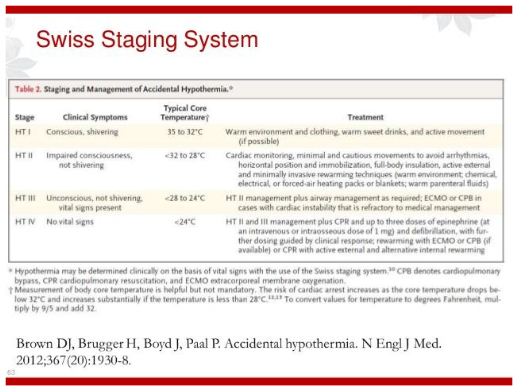
PromptComplications of hypothermia/systemic effects of hypothermia
ResponseResp - respiratory depression, suppressed gag/cough, aspiration
Cardiac - Bradycardia, hypotension, arrhythmia (slow AF, VF)
CNS - Decreased LOC
Renal - AKI, Rhabdo, cold diuresis
Haem - DIC, thrombosis
Metabolic - metabolic and respiratory acidosis, hypoglycaemia
GIT - pancreatitis
Cardiac - Bradycardia, hypotension, arrhythmia (slow AF, VF)
CNS - Decreased LOC
Renal - AKI, Rhabdo, cold diuresis
Haem - DIC, thrombosis
Metabolic - metabolic and respiratory acidosis, hypoglycaemia
GIT - pancreatitis
PromptBloods - abnormalities
ResponseEUC’s - AKI
CK - Rhabdo
FBC - thrombocytopaenia - Marrow suppression, Splenic sequestration (?DIC)
Coags/fibrinogen/INR - DIC
Lactate - Hypoperfusion, sepsis
CK - Rhabdo
FBC - thrombocytopaenia - Marrow suppression, Splenic sequestration (?DIC)
Coags/fibrinogen/INR - DIC
Lactate - Hypoperfusion, sepsis
PromptECG interpretation + Describe changes
ResponseT wave inversion
PR/QRS/QT prolongation
Osborne (J) waves - Positive deflection seen at the J appoint in precordial and true limb leads typically seen when T<30 deg.
Sinus bradycardia
AF
AV block
(VF)
PR/QRS/QT prolongation
Osborne (J) waves - Positive deflection seen at the J appoint in precordial and true limb leads typically seen when T<30 deg.
Sinus bradycardia
AF
AV block
(VF)
PromptWarming techniques in hypothermia + indications for each
ResponseRemove wet clothing and dry patient (passive rewarming)
Peripheral active warming
Peripheral active warming
- warm blankets, bair hugger, (+/- radiant heater) (all pts <35c)
- Warm IV fluids - give if needs fluids (Prevents cooling rather than warms)
- Body cavity lavage - Bladder if IDC indicated, Gastric, peritoneal (3deg/hr), symptomatic hypothermia
- Warmed humidified air (1-1.5 deg/hr)
- Gastric lavage - tubed patients only
- Pleural lavage (Right side) - Cardiac arrest - 6 deg/hr
- Bypass/ECMO - Cardiac arrest - 9-18 deg/hr!
PromptManagement of hypothermia (non warming stuff)
ResponseWarming (See above)
Confirm core temperature + continuous monitoring (Rectal/oesophageal)
Airway patency + ventilation/oxygenation
Optomise haemodynamics + ensure vital organ perfusion (dispoportionate hypotension/bradycardia with degree of hypothermia)
Search for precipitant/secondary causes. Correct (Some are rapid eg: BSL)
Exclude trauma, C spine protection
READ THE STEM “Pulled from the sea” etc. Address specifics from stem
Confirm core temperature + continuous monitoring (Rectal/oesophageal)
Airway patency + ventilation/oxygenation
Optomise haemodynamics + ensure vital organ perfusion (dispoportionate hypotension/bradycardia with degree of hypothermia)
Search for precipitant/secondary causes. Correct (Some are rapid eg: BSL)
Exclude trauma, C spine protection
READ THE STEM “Pulled from the sea” etc. Address specifics from stem
PromptIntubation pros + cons
ResponsePro:
Airway protection, decreas aspiration risk
Further assessment (eg: CT)
Rapid rewarming - 2deg/hr with warm air ventilation
Correct respiratory acidosis
Optomise oxygenation
Cons:
Arrhythmia - high risk
Modified drugs - Slow onset and prolonged effects
Resource intense (1:1 nursing etc.)
Intubation may be avoidable if warmed up
Airway protection, decreas aspiration risk
Further assessment (eg: CT)
Rapid rewarming - 2deg/hr with warm air ventilation
Correct respiratory acidosis
Optomise oxygenation
Cons:
Arrhythmia - high risk
Modified drugs - Slow onset and prolonged effects
Resource intense (1:1 nursing etc.)
Intubation may be avoidable if warmed up
PromptGeneral considerations in hypothermia resus
ResponseOptimal rate/technique of CPR largely unknown
DC shocks inefficient
Drugs impaired (absorption + metabolism)
Too much handling can cause VF
DC shocks inefficient
Drugs impaired (absorption + metabolism)
Too much handling can cause VF
PromptVF management in hypothermia (ALS modifications)
ResponseSpecific:
No drugs until >30c then double intervals
No defib until > 30c (Ineffective in hypothermia) - expect rhythm to be refractory (some guidelines state shock 1-3 times initially then await warming)
Duration - Prolonged (up to 2h common) - Continue until >32 deg
General
Concurrent aggressive warming is critical
If VF reverts, expect regression back to VF
Suspect hyperkalaemia + treat aggressively
Heroics - Early call for ECMO CPR
Intubate sooner, rather than later
Chest may be stiff -makes compressions harder, consider using LUCAS
No drugs until >30c then double intervals
No defib until > 30c (Ineffective in hypothermia) - expect rhythm to be refractory (some guidelines state shock 1-3 times initially then await warming)
Duration - Prolonged (up to 2h common) - Continue until >32 deg
General
Concurrent aggressive warming is critical
If VF reverts, expect regression back to VF
Suspect hyperkalaemia + treat aggressively
Heroics - Early call for ECMO CPR
Intubate sooner, rather than later
Chest may be stiff -makes compressions harder, consider using LUCAS