RENAL AND ELECTROLYTE
HYPERKALAEMIA
PromptECG findings of hyperkalaemia
Peaked T waves
P wave widening + flattening, PR prolongation >> sinusoidal
Bradyarrhythmias - Sinus brady, high grade AV block with slow escape rhythms (Ventricular/junctional), slow AF
Conduction blocks (BBB, Fascicular blocks)
QRS widening with bizarre QRS morphology, sinusoidal
Sine wave >> VF >> PEA>> Coffin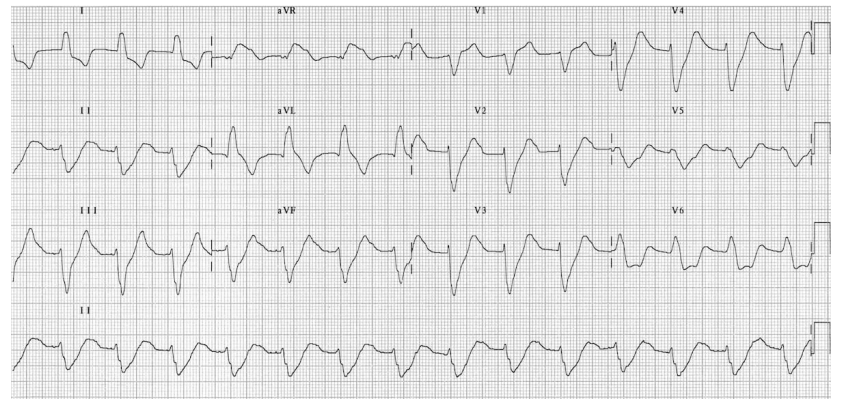
Peaked T waves
P wave widening + flattening, PR prolongation >> sinusoidal
Bradyarrhythmias - Sinus brady, high grade AV block with slow escape rhythms (Ventricular/junctional), slow AF
Conduction blocks (BBB, Fascicular blocks)
QRS widening with bizarre QRS morphology, sinusoidal
Sine wave >> VF >> PEA>> Coffin
- Mostly LITFL
Response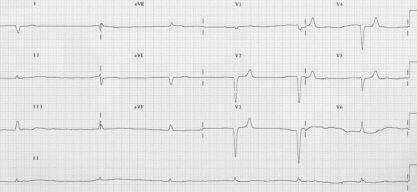

PromptManagement of hyperkalaemia + Comment on the below
Response
PromptCalcium Gluconate
ResponseCalcium gluconate (10% 10 mL-30mL)
Stabilises cardiac membrane - protects against hyperkalaemic effect
Endpoint: Repeat to achieve narrow QRS <120ms
Onset <5 mins
Duration 30-60 min
Stabilises cardiac membrane - protects against hyperkalaemic effect
Endpoint: Repeat to achieve narrow QRS <120ms
Onset <5 mins
Duration 30-60 min
PromptSodium Bicarbonate
ResponseSodium Bicarbonate (1mmol/kg) - Alkalosis shifts K directly into cells through action of Hydrogen and Potassium channels
Endpoint either K<6, pH >7.5
Onset 15 mins
duration 1-2h
Endpoint either K<6, pH >7.5
Onset 15 mins
duration 1-2h
PromptSalbutamol
ResponseSalbutamol Nebulised route if possible (5-10mg) or IV 5mics/kg - Acts on B-receptor to simulate K+ reuptake
Endpoint K<6
Onset 15 mins
Duration 1-2 hours
Endpoint K<6
Onset 15 mins
Duration 1-2 hours
PromptInsulin
ResponseInsulin - 10U + 50 mL 50% destrose (if BSL <15) - Facilitate increased uptake of K+ into cells
Endpoint K<6
Onset 30 mins
Duration 2-4 hours
Endpoint K<6
Onset 30 mins
Duration 2-4 hours
PromptResonium
ResponseResonium - 30g PO/PR - Ion binding
onset 2 hours,
Duration 6 hours
onset 2 hours,
Duration 6 hours
PromptManagement of Hyperkalaemic arrest
ResponseProtect the heart: give 10 mL calcium chloride 10% IV by rapid bolus injection or 30ml of calcium gluconate
Shift potassium into cells: Give glucose/insulin: 10 units short-acting insulin and 25 g glucose IV by rapid injection. Monitor blood glucose.
Give sodium bicarbonate: 50 mmol IV by rapid injection (if severe acidosis or renal failure).
Remove potassium from body: Consider dialysis for hyperkalaemic cardiac arrest resistant to medical treatment. Several dialysis modalities have been used safely and effectively in cardiac arrest, but this may only be available in specialist centres.
Consider use of a mechanical chest compression device if prolonged CPR is needed.
Shift potassium into cells: Give glucose/insulin: 10 units short-acting insulin and 25 g glucose IV by rapid injection. Monitor blood glucose.
Give sodium bicarbonate: 50 mmol IV by rapid injection (if severe acidosis or renal failure).
Remove potassium from body: Consider dialysis for hyperkalaemic cardiac arrest resistant to medical treatment. Several dialysis modalities have been used safely and effectively in cardiac arrest, but this may only be available in specialist centres.
Consider use of a mechanical chest compression device if prolonged CPR is needed.
PromptIntubation + hyperventilation
ResponsepH ~7.5 - alkalosis drives potassium intracellulrly
PromptDialysis in Hyperkalaemia
ResponseRefractory hyperkalaemia, dialysis required for other indications. Not really an ED intervention
PromptAdditional management of hyperkalaemia (not potassium specific)
ResponseIDC + fluid balance
Optomise fluid status and haemodynamics
Seek and treat cause (AKI?/?Sepsis, ? needs ureteric stent)
Optomise fluid status and haemodynamics
Seek and treat cause (AKI?/?Sepsis, ? needs ureteric stent)
PromptHyperkalaemia investigations
ResponseECG - ECG changes and track resolution
Renal tract imaging (U/S or CT or bladder scanner) - post renal obstruction as cause for AKI
Urine Casts+Protein - Renal cause of AKI (eg: ATN)
Urine MCS - exclude UTI
Inflammatory markers ? Infection
Renal tract imaging (U/S or CT or bladder scanner) - post renal obstruction as cause for AKI
Urine Casts+Protein - Renal cause of AKI (eg: ATN)
Urine MCS - exclude UTI
Inflammatory markers ? Infection
PromptHYPOKALAEMIA
ResponseMost questions are from anorexia questions
PromptECG changes of hypokalaemia
ResponseIncreased P amplitude
Prolonged PR
Widespread ST depression and T wave flattening/inversion (K up T up, K down T down)
Prominent U waves best seen in praecordial leads V2-V3
Apparent long QT (merging of T with U)
Worsening hypokalaemia - supraventricular and ventricular ectopics
Supraventricular tachyarrhythmias (AF/Flutter/Atrial tachycardia)
Potential to develop life threatening ventricular arrhythmias (VT/VF/Torsades)
Prolonged PR
Widespread ST depression and T wave flattening/inversion (K up T up, K down T down)
Prominent U waves best seen in praecordial leads V2-V3
Apparent long QT (merging of T with U)
Worsening hypokalaemia - supraventricular and ventricular ectopics
Supraventricular tachyarrhythmias (AF/Flutter/Atrial tachycardia)
Potential to develop life threatening ventricular arrhythmias (VT/VF/Torsades)
- Bits from LITFL + answers
PromptOptions to replace potassium
ResponseOral - 40mmol q6h - rapid absorption formula indicated (Chlorvescent)
Pro - Avoid IV complications of rapid infusion/pain. Can give NG
Cons - Unpleasant taste, Eating disorder patient compliance
IV - 40mmol/hr peripheral (???)
Pros - Avoids compliance issues, titrate to repeat VBG measurements
Cons - Pain/irritation, danger of overdosing, Needs cardiac monitoring
Pro - Avoid IV complications of rapid infusion/pain. Can give NG
Cons - Unpleasant taste, Eating disorder patient compliance
IV - 40mmol/hr peripheral (???)
Pros - Avoids compliance issues, titrate to repeat VBG measurements
Cons - Pain/irritation, danger of overdosing, Needs cardiac monitoring