O+G
PREGNANT TRAUMA
PromptList important maternal obstetric history when assessing obstetric trauma
ResponseGestation in weeks + any complications
Foetal lie/placental location
Blood type/Rh status
Previous pregnancy/birth complications
DOMESTIC VIOLENCE STUFF
Foetal lie/placental location
Blood type/Rh status
Previous pregnancy/birth complications
DOMESTIC VIOLENCE STUFF
PromptList physiologic changes during pregnancy and their implications for assessment/management in trauma
Response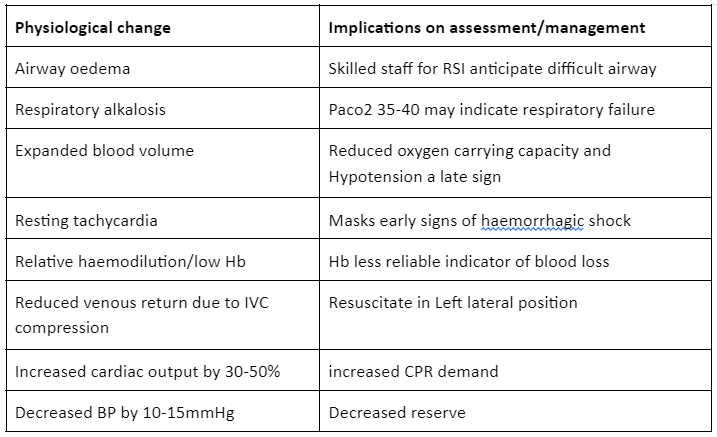
PromptList conditions specific to trauma in pregnancy
ResponseFetal distress
Placental abruption
Amniotic fluid embolism
Uterine injury/rupture
Laceration of placenta or cord
Premature rupture of membranes
Premature labour
Foetomaternal haemorrhage
Direct fetal injury
Placental abruption
Amniotic fluid embolism
Uterine injury/rupture
Laceration of placenta or cord
Premature rupture of membranes
Premature labour
Foetomaternal haemorrhage
Direct fetal injury
PromptBriefly discuss the purpose, indications, duration of CTG monitoring post trauma. List abnormalities that would concern you
ResponsePurpose – detect uterine contractions which might suggest abruption/uterine irritability, assess for foetal distress/hypoxia
Gestation – greater than 22-24 weeks – no role prior to that
Duration – 4-6 hours in minor trauma – 24 hours in severe trauma or if any abnormalities in first 4-6 hours
3 abnormalities – premature contractions, foetal tachycardia, foetal bradycardia, loss of beat-to-beat variability, late deceleration after contractions
Gestation – greater than 22-24 weeks – no role prior to that
Duration – 4-6 hours in minor trauma – 24 hours in severe trauma or if any abnormalities in first 4-6 hours
3 abnormalities – premature contractions, foetal tachycardia, foetal bradycardia, loss of beat-to-beat variability, late deceleration after contractions
PromptList a pregnancy specific examination in trauma
ResponseUterine examination- fundal height, tenderness, contractions
PromptList pregnancy specific investigations in trauma and their indications
ResponseCTG- role debatable between 24-28/40 but early sensitivity for abnormal fetal HR
Ultrasound- useful as FAST, examination of solid organ injury, confirm fetal presentation and gestation, placental location and amniotic fluid volume. Not a good predictor of placental injury.
Blood test- Kleihauer, to determine amount of Anti-D required for fetomaternal haemorrhage
Ultrasound- useful as FAST, examination of solid organ injury, confirm fetal presentation and gestation, placental location and amniotic fluid volume. Not a good predictor of placental injury.
Blood test- Kleihauer, to determine amount of Anti-D required for fetomaternal haemorrhage
PromptTraumatic injuries - For the below list clinical findings
ResponseIntentionally blank
PromptPlacental abruption
ResponseAbdominal pain/tenderness
Vaginal bleeding.
Uterine contractions.
Uterine tenderness/tenseness/Woody feeling
Expanding fundal height.
Evidence of foetal compromise.
Maternal haemodynamic instability
Vaginal bleeding.
Uterine contractions.
Uterine tenderness/tenseness/Woody feeling
Expanding fundal height.
Evidence of foetal compromise.
Maternal haemodynamic instability
PromptUterine Rupture
ResponseLoss of palpable uterine contour
Palpable foetal parts.
Positive FAST scan.
Maternal shock.
Vaginal bleeding.
Palpable foetal parts.
Positive FAST scan.
Maternal shock.
Vaginal bleeding.
PromptPremature labour/Rupture of membranes
ResponseUterine contractions.
Bloody show.
Bloody show.
PromptFoeto-maternal Haemorrhage
ResponseFoetal distress on CTG.
Positive Kleihauer Betke test.
Positive Kleihauer Betke test.
PromptAmniotic fluid embolism
ResponseCardiorespiratory collapse/arrest
DIC (increased D-dimer /PT /APTT /FDPs,
decreased antithrombin /protein C / platelets
/fibrinogen /clotting factors).
Foetal distress on CTG.
Seizure.
DIC (increased D-dimer /PT /APTT /FDPs,
decreased antithrombin /protein C / platelets
/fibrinogen /clotting factors).
Foetal distress on CTG.
Seizure.
PromptFoetal Demise
ResponseAbsent FHR
Absent Foetal Movement
Absent Foetal Movement
PromptPre arrival preparation pregnant trauma
ResponsePASTED Mnemonic! - 2 patients, mother + baby.
2 teams - mother + Baby
Call O+G and paeds
Mgmt of rest of department
Equipment
2 teams - mother + Baby
Call O+G and paeds
Mgmt of rest of department
Equipment
- Maternal resus - airway, drugs, wedge for L lateral
- Neonatal - resusciataire, neonatal trolley, airway equipment, drugs
- Perimortem C section kit
PromptManagement of painless heavy bright red PV bleeding with pregnant trauma
ResponseResuscitate the mother if signs of shock – IV fluid boluses aiming for MAP > 60
Check fetal heartrate with USS +/- CTG if available
Urgently notify with O&G and theatre re possible placental abruption & possible need for urgent delivery of fetus
Large bore IV Access & bloods sent for Xmatch
Urgent USS to assess for fetal wellbeing, abruption, uterine rupture, placenta praevia
Speculum examination by O&G team to assess causes of bleeding
Steroids for fetal lung maturation (Betamethasone 12mg)
Check fetal heartrate with USS +/- CTG if available
Urgently notify with O&G and theatre re possible placental abruption & possible need for urgent delivery of fetus
Large bore IV Access & bloods sent for Xmatch
Urgent USS to assess for fetal wellbeing, abruption, uterine rupture, placenta praevia
Speculum examination by O&G team to assess causes of bleeding
Steroids for fetal lung maturation (Betamethasone 12mg)
PromptManagement of pregnant traumatic arrest
ResponseContinue CPR
Oxygenation BVM 15L/min
Adrenaline 1mg every 2nd cycle
Prepare for resuscitative hysterotomy
Seek + treat reversible causes
(As per ALS guidelines for asystole - pretty much unchanged from non pregnant)
CTG pads removed before shock
Oxygenation BVM 15L/min
Adrenaline 1mg every 2nd cycle
Prepare for resuscitative hysterotomy
Seek + treat reversible causes
(As per ALS guidelines for asystole - pretty much unchanged from non pregnant)
CTG pads removed before shock
PromptIndications for resuscitative hysterotomy
ResponseMaternal cardiac arrest
Within 5 mins of arrest (answers vary (4-15mins) - LITFL says if CPR doesn’t work by 4 mins start cutting, UK guidelines - “by 5 mins, or if maternal fatal injuries or prolonged pre hospital arrest”
Gestational age >20 (?24) weeks (Uterus palpable above umbilicus)
Within 5 mins of arrest (answers vary (4-15mins) - LITFL says if CPR doesn’t work by 4 mins start cutting, UK guidelines - “by 5 mins, or if maternal fatal injuries or prolonged pre hospital arrest”
Gestational age >20 (?24) weeks (Uterus palpable above umbilicus)
PromptDescribe how a resuscitative hysterotomy is performed
ResponsePrep skin with iodine/chlorhex (if time - one q specifically mentioned no marks for sterility)
Vertical incision from pubis to umbilicus (xyphoid in some resources)
Divide to peritoneum, (Blunt vs scissors) to open peritoneum
Vertical incision in uterus (Scalpal to allow scissors - then safety scissors for rest of incision)
Deliver baby: Hand through incision, deliver head, may require fundal pressure
Hand baby over to neonatal team assembled.
Clamp and cut cord
Deliver placenta - Scoop out with hand, gentle traction on cord
Fundus massage + Pack uterus
Syntocinon 30 U
Continue resuscitation of mother
Vertical incision from pubis to umbilicus (xyphoid in some resources)
Divide to peritoneum, (Blunt vs scissors) to open peritoneum
Vertical incision in uterus (Scalpal to allow scissors - then safety scissors for rest of incision)
Deliver baby: Hand through incision, deliver head, may require fundal pressure
Hand baby over to neonatal team assembled.
Clamp and cut cord
Deliver placenta - Scoop out with hand, gentle traction on cord
Fundus massage + Pack uterus
Syntocinon 30 U
Continue resuscitation of mother
PromptDiscuss different modalities of trauma imaging in pregnancy + justification for their use
ResponseFAST scan - similar sensitivity to non pregnant patient, identify free fluid
Formal U/S - confirm gestational age, FHR, fetal vulnerability/activity/presentation, amniotic fluid volume, solid organ injury
CTAP - Risk of radiation small compared to missed traumatic injury. Fetal vulnrability worst <15 weeks. Will define injuries + mgmt
Formal U/S - confirm gestational age, FHR, fetal vulnerability/activity/presentation, amniotic fluid volume, solid organ injury
CTAP - Risk of radiation small compared to missed traumatic injury. Fetal vulnrability worst <15 weeks. Will define injuries + mgmt
PromptOutline uses for Ultrasound in pregnant trauma
ResponseFetal heart beat – does not negate the need for CTG
FAST exam – Accuracy limited by gravid uterus, positive scan still of use
Assessment for abruption – May miss up to 50%, poor Sensitivity
Pneumothorax – May be more accurate than CXR, can help identify site for
insertion of ICC
FAST exam – Accuracy limited by gravid uterus, positive scan still of use
Assessment for abruption – May miss up to 50%, poor Sensitivity
Pneumothorax – May be more accurate than CXR, can help identify site for
insertion of ICC
PromptDiscuss CTG in Trauma
ResponsePurpose – detect uterine contractions which might suggest abruption/uterine irritability, assess for foetal distress/hypoxia
Gestation – greater than 22-24 weeks – no role prior to that
Duration – 4-6 hours in minor trauma – 24 hours in severe trauma or if any abnormalities in first 4-6 hours
3 abnormalities – premature contractions, foetal tachycardia, foetal bradycardia, loss of beat-to-beat variability, late deceleration after contractions
Gestation – greater than 22-24 weeks – no role prior to that
Duration – 4-6 hours in minor trauma – 24 hours in severe trauma or if any abnormalities in first 4-6 hours
3 abnormalities – premature contractions, foetal tachycardia, foetal bradycardia, loss of beat-to-beat variability, late deceleration after contractions
PromptWhat is the Kleihauer test and what is its utility
ResponseUse in Rh negative mother to assess severity of foetomaternal haemorrhage
Used to confirm the dose of Anti D required post a sensitising event (Trauma/bleed)
If Kleihauer >6 mL will need increased dose (more than usual 625 IU)
Used to confirm the dose of Anti D required post a sensitising event (Trauma/bleed)
If Kleihauer >6 mL will need increased dose (more than usual 625 IU)
PromptSafe discharge criteria in pregnant trauma
ResponseNormal examination with no abdominal tenderness, bruising or contractions
No PV loss or discharge
Normal fetal movements
Safe discharge environment- s/work, explored DV, increased antenatal surveillance
No PV loss or discharge
Normal fetal movements
Safe discharge environment- s/work, explored DV, increased antenatal surveillance
You WILL be asked about maternal physiologic changes in pregnancy