NEUROLOGY + NEUROSURGERY
BLUNT CVA
PromptRisk factors for blunt CVA
ResponseNeck trauma
Connective tissue disease
Near hanging with anoxic brain injury
- C spine injuries (Fractures involving transverse foramen, C spine subluxation)
- Base of skull #’s
- Severe facial injuries
Connective tissue disease
Near hanging with anoxic brain injury
PromptSigns/symptoms of blunt CVA
ResponseFocal neurologic deficit
Cervical bruit or thrill
Expanding neck haematoma
Neuro exam inconsistent with CT brain
Infarct on CT brain
Cervical bruit or thrill
Expanding neck haematoma
Neuro exam inconsistent with CT brain
Infarct on CT brain
PromptScreening tool for blunt CVA
ResponseDenver screening criteria - risk factors and sings/symptoms
PromptImaging in blunt CVA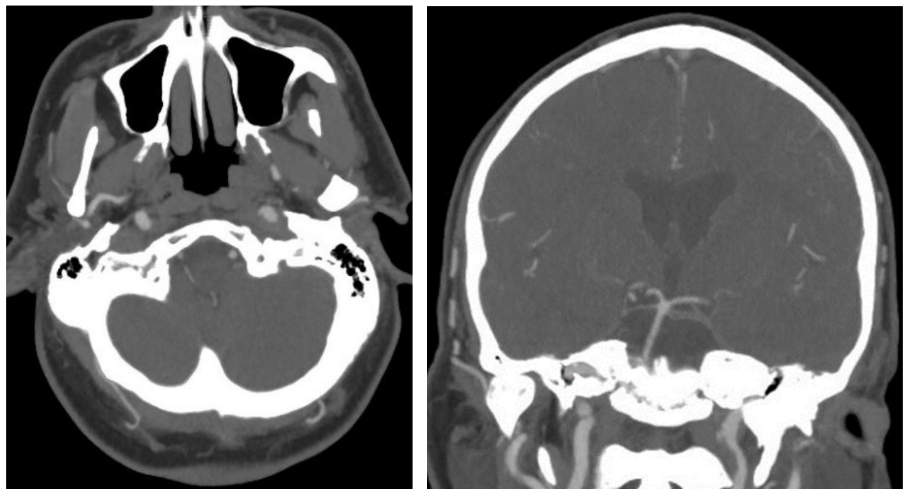
ResponseNarrowed lumen of L carotid (coronal)
Crescent shaped irregularity in L carotid artery consistent with thrombus (Axial)
Outpouching from L carotid superior to narrowing likely associated aneurysm
Filling defect L carotid artery
Reduced contrast in teritorises distal to L carotid
No ICH as alternative for symptoms
Crescent shaped irregularity in L carotid artery consistent with thrombus (Axial)
Outpouching from L carotid superior to narrowing likely associated aneurysm
Filling defect L carotid artery
Reduced contrast in teritorises distal to L carotid
No ICH as alternative for symptoms
PromptList the 2 major vessels involved in blunt CVA
ResponseInternal carotid artery dissection
Vertebral artery dissection (As it passes through transverse foramina)
Vertebral artery dissection (As it passes through transverse foramina)
PromptInternal carotid dissection features
ResponseMore common than vertebral artery, more commonly injured from external pressure
Unilateral headache (Frontotemporal) - severe, may mimic SAH/previous migraine
Anterior neck pain
Partial horner syndrome (Ptosis and miosis)
Cranial nerve palsies
Unilateral headache (Frontotemporal) - severe, may mimic SAH/previous migraine
Anterior neck pain
Partial horner syndrome (Ptosis and miosis)
Cranial nerve palsies
PromptVertebral artery dissection
ResponseHeadache (occipital, bilateral)
Posterior neck pain
Facial parasthesia
Lateral medullary syndrome (basic description - ipsilateral cranial nerve, contralateral sensory below the face)
Diplopia, ataxia (Cerebellar signs)
Posterior neck pain
Facial parasthesia
Lateral medullary syndrome (basic description - ipsilateral cranial nerve, contralateral sensory below the face)
Diplopia, ataxia (Cerebellar signs)
PromptManagement options for dissection
ResponseSmall area of thrombus with no flap = antiplatelet
Moderate to large thrombus with/without flap = anticoagulation (heparin or DOAC)
Persistent ischaemia despite medical management = Surgical management with stent
Moderate to large thrombus with/without flap = anticoagulation (heparin or DOAC)
Persistent ischaemia despite medical management = Surgical management with stent
Stem - MVA + neck pain, Neck pain + headache carrying child on shoulders