ORTHOPAEDICS - ADULT
COMPARTMENT SYNDROME
PromptRisk factors for compartment syndrome (in addition to trauma)
ResponseHighly muscular individuals
Less flexible fascia (young males)
Higher energy injuries
Anabolic steroids
Presence of coagulopathy
Less flexible fascia (young males)
Higher energy injuries
Anabolic steroids
Presence of coagulopathy
PromptNon fracture causes of compartment syndrome
ResponseAcute extremity ischaemia with reperfusion
Burn
Crush
Spontaneous haemorrhage/haematoma
Soft tissue infection
Non traumatic myositis/myonecrosis/rhabdomyolisis
SIRS with massive fluid resuscitation
High pressure injection
Intravenous extravasation injury
Intra-arterial injection
Prolonged immobilisation
Venomous bites/stings
Tight cast/splint/dressing
Closure of fascial defects
Burn
Crush
Spontaneous haemorrhage/haematoma
Soft tissue infection
Non traumatic myositis/myonecrosis/rhabdomyolisis
SIRS with massive fluid resuscitation
High pressure injection
Intravenous extravasation injury
Intra-arterial injection
Prolonged immobilisation
Venomous bites/stings
Tight cast/splint/dressing
Closure of fascial defects
PromptMethods of assessing for compartment syndrome
ResponseClinical
History
History
- pain out of proportion to apparent injury, persistent deep ache or burning pain, parsthesia
- Tense compartment, Pain with passive stretch, paresthesia (Decreased sensation and weakness), paralysis (late finding), pallor from vascular insufficiency, poikilothermia, (+/- pulselessness)
- Stryker needle – proprietary device with special needle with side ports – attaches to a pressure measuring component in the Stryker kit
- “Normal” large bore needle or cannula attached to standard IV line and transduced as one would an arterial or CVP line (zero it etc)
PromptExplain Delta Pressure in diagnosing compartment syndrome
ResponseNormal compartment pressure is 0-8 mm.Hg
Preferred measure over measured compartment pressure is “Delta pressure”
Delta pressure = diastolic BP - measured compartment pressure
<20-30 indicates need for fasciotomy (ie: if compartment pressure is within 20-30 of DBP you have problems)
Preferred measure over measured compartment pressure is “Delta pressure”
Delta pressure = diastolic BP - measured compartment pressure
<20-30 indicates need for fasciotomy (ie: if compartment pressure is within 20-30 of DBP you have problems)
PromptAnterior compartment of lower limb is the most common place for compartment syndrome. List specific findings for this
ResponseContains extensor muscles of foot, anterior tibial artery, deep peroneal nerve
Loss of sensation DPN (First webspace)
Weakness of foot dorsiflexion
Late = foot drop, “Claw foot” and DPN nerve dysfunction
Loss of sensation DPN (First webspace)
Weakness of foot dorsiflexion
Late = foot drop, “Claw foot” and DPN nerve dysfunction
PromptImmediate management of compartment syndrome
ResponseElevation + Ice
Remove external compression (Splints, slabs, bandages)
Analgesia
Immediate orthopaedic attendance for fasciotomy
Remove external compression (Splints, slabs, bandages)
Analgesia
Immediate orthopaedic attendance for fasciotomy
PromptIndications for urgent fasciotomy in compartment syndrome
ResponseEvidence of vascular compression
Late presentation or diagnosis
Significant neurologic dysfunction
Compartment pressure >30mm.Hg, Delta pressure (diastolic -compartment pressure) >30 mm.Hg
Rhabdo (Myoglobin release continues until ischaemia is relieved)
Late presentation or diagnosis
Significant neurologic dysfunction
Compartment pressure >30mm.Hg, Delta pressure (diastolic -compartment pressure) >30 mm.Hg
Rhabdo (Myoglobin release continues until ischaemia is relieved)
PromptComplications of compartment syndrome
ResponseGangrene/loss of limb viability requiring amputation
Ischaemic contracture and loss of function
Rhabdomyolysis and renal failure
Ischaemic contracture and loss of function
Rhabdomyolysis and renal failure
PromptCons of Mannitol for Compartment/Crush injury
Responselack of proven efficacy in preventing renal injury or need for dialysis (beyond that provided by aggressive volume increased UO) causing big fluid shifts and contributing to hypovolaemia/hypotension are potentially bad ideas in a polytrauma patient
potential haemoconcentration/increased viscosity
effects on ICP
allergy/anaphylaxis
Apparently may reduce renal injury from tubular deposition
potential haemoconcentration/increased viscosity
effects on ICP
allergy/anaphylaxis
Apparently may reduce renal injury from tubular deposition
PromptOPEN FRACTURE
Response
PromptGustillo classification of open fractures
(Note originally for tib/fib fractures but seems to be widely applied)
(Note originally for tib/fib fractures but seems to be widely applied)
ResponseGrade 1 - Open fracture <1cm and clean
Grade 2 - Laceration 1-10cm without extensive soft tissue damage
Grade 3
3A - >10cm, Extensive soft tissue injury or contaminated, adequate tissue for coverage(Or contaminated sewerage/farm automatically 3A regardless of size)
3B - Periosteal stripping - requires soft tissue coverage (Flap)
3C - Vascular injury requiring repair
Grade 2 - Laceration 1-10cm without extensive soft tissue damage
Grade 3
3A - >10cm, Extensive soft tissue injury or contaminated, adequate tissue for coverage(Or contaminated sewerage/farm automatically 3A regardless of size)
3B - Periosteal stripping - requires soft tissue coverage (Flap)
3C - Vascular injury requiring repair
PromptAntibiotic choice
ResponseABx within 3 hours
Cefazolin 2g (50 mg/kg) - gram positive (Eg: Staph)
If significantly contaminated - Add metronidazole 500 mg 12.5mg/kg) IV Q12H
Penicillin allergy - swap to Clinda 600 mg (15 mg/kg) IV Q8H
Water borne organisms eg: Vibrio
Cefazolin + Ciprofloxacin 400 mg (10 mg/kg) (+Metro if contaminated)
Penicillin allergy = Clinda + Cipro
ADT/Tetanus immunoglobulin
Note: Tazocin is for treatment of infection, not prophylaxis.
eTG May ‘26
Cefazolin 2g (50 mg/kg) - gram positive (Eg: Staph)
If significantly contaminated - Add metronidazole 500 mg 12.5mg/kg) IV Q12H
Penicillin allergy - swap to Clinda 600 mg (15 mg/kg) IV Q8H
Water borne organisms eg: Vibrio
Cefazolin + Ciprofloxacin 400 mg (10 mg/kg) (+Metro if contaminated)
Penicillin allergy = Clinda + Cipro
ADT/Tetanus immunoglobulin
Note: Tazocin is for treatment of infection, not prophylaxis.
eTG May ‘26
PromptSEPTIC ARTHRITIS VS GOUT
ResponseI got really lazy here. Probably needs a second look
PromptDifferentials for a red, hot, swollen joint
Response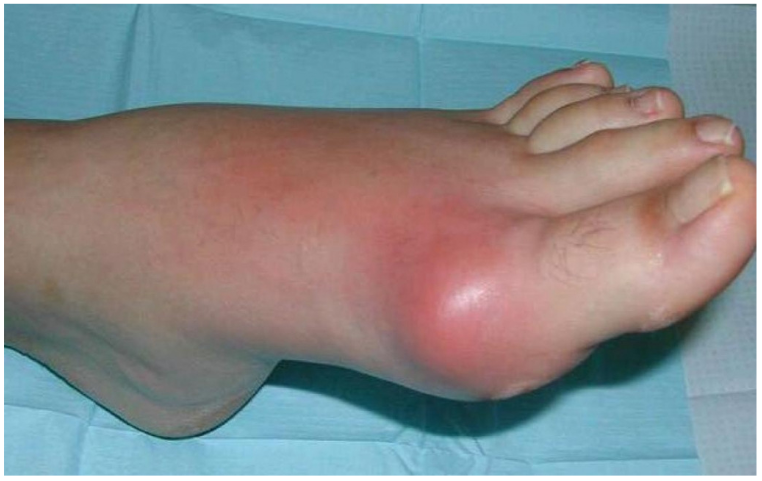
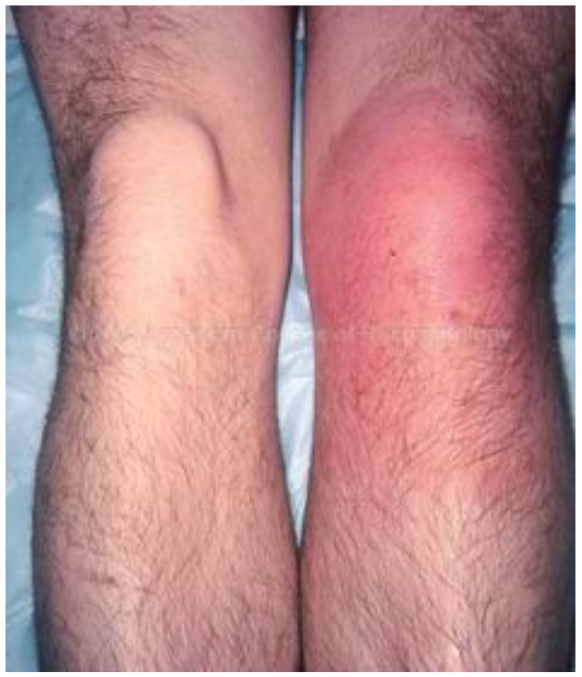
PromptBest investigation for red hot swollen joint + interpretation
ResponseJoint aspirate for M/C/S and cell count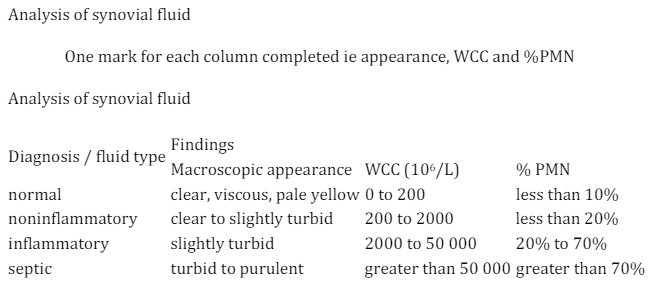
- May give diagnosis for crystal or septic joint, Directs antibiotic therapy, Direct future preventative measures
- Painful, operator dependant, Risk of introducing infection
- cell count – greater than 50 000
- Organisms on Gram stain / also accept “no crystals”
- Note crystals doesn’t exclude septic arthritis. You can have gout and SA
- Cell count generally less than 50 000
- Negatively bi-refringent crystals
PromptOther investigations - pros and cons
Response
PromptGout
Risk factors, aspirate findings, Treatment
Risk factors, aspirate findings, Treatment
ResponseRisk factors
Renal failure, chemotheraputics, FHx, Diuretics (thiazide, loop), Dietary (high purine foods, alcohol), Hyperuricaemia
Aspirate: negatively birefringent crystals, WBC 200 - 50,000, yellow, turbid fluid.
Colchicine 500 mg BD, Prednisone 50 mg 3 days, NSAIDS eg Ibuprofen 400 mg TDS
Renal failure, chemotheraputics, FHx, Diuretics (thiazide, loop), Dietary (high purine foods, alcohol), Hyperuricaemia
Aspirate: negatively birefringent crystals, WBC 200 - 50,000, yellow, turbid fluid.
Colchicine 500 mg BD, Prednisone 50 mg 3 days, NSAIDS eg Ibuprofen 400 mg TDS
PromptPseudogout
ResponseCalcium pyrophosphate crystal on aspirate
Analgesia
Analgesia
PromptHaemarthrosis/Trauma
ResponseFrank blood on aspirate
Conservative, aspirate for comfort, NWB< reverse coagulopathy, manage trauma
Conservative, aspirate for comfort, NWB< reverse coagulopathy, manage trauma
PromptSeptic arthtitis
ResponseSkin manifestations
Pathogens: Staphylococcus, gonoccoccal
Note gram NEGATIVE diplococci = Neisseria or Moraxella. Gram POSITIVE diplococci = Strep orEnterococcus
Aspirate: Organisms on gram stain, Cell count >50,000
Theatre for washout + IV antibiotics (Flucloxacillin 1g QID, Cefzolin 2g TDS)
Pathogens: Staphylococcus, gonoccoccal
Note gram NEGATIVE diplococci = Neisseria or Moraxella. Gram POSITIVE diplococci = Strep orEnterococcus
Aspirate: Organisms on gram stain, Cell count >50,000
Theatre for washout + IV antibiotics (Flucloxacillin 1g QID, Cefzolin 2g TDS)
PromptAntibiotics for septic arthritis
ResponseUnknown or Gram positive cocci in clusters
Fluclox 2g QID
+/- Vanc if MRSA
Clinda if penicillin allergies
Gram positive cocci in chains (Strep)
Ceftriaxone 2g
eTG Nov 24
Fluclox 2g QID
+/- Vanc if MRSA
Clinda if penicillin allergies
Gram positive cocci in chains (Strep)
Ceftriaxone 2g
eTG Nov 24
PromptDisseminated gonococcal infection
ResponseVisible rash sparing head - classically patechial or painful red papules on distal extremities
PromptReactive arthritis
ResponseIBD, Gonococcal, Reiter’s
PromptInflammatory
ResponseRheumatoid, SLE, Psoriatic (uncommon for knee), Bursitis
PromptDegenerative
ResponseOA
PromptAcute rheumatic fever (If indigenous)
Response
PromptThere was a whole segment on what investigations to order.
ResponseOrder an aspirate and MCS including crystals
sensible shit and justify it. I’m fucking done
sensible shit and justify it. I’m fucking done
PromptConsent for arthrocentesis
ResponseCondition suspected/present
Proposed procedure
Risk of procedure
Risk of not doing procedure
Alternatives
Proposed procedure
Risk of procedure
Risk of not doing procedure
Alternatives