RESPIRATORY
ARDS
Prompt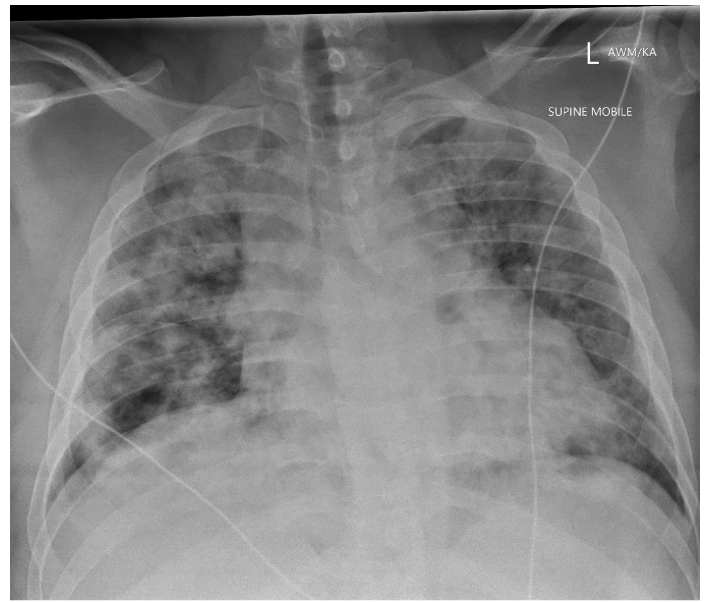
ResponseBilateral
Patchy with areas of confluence
Consolidation
Symmetrical
Patchy with areas of confluence
Consolidation
Symmetrical
PromptPF ratio in ARDS
ResponsePF ratio = PaO2/FiO2
Mild 200-300
Moderate 100-200
Severe <100
Mild 200-300
Moderate 100-200
Severe <100
PromptInvestigation in ARDS
ResponseCovid/viral swabs - cause, isolation
Blood culture - culture organism go narrow antimicrobial spectrum
Urine strep antigen - quickly identify strep to allow focussed antibiotics
Chlamydia/legionella tire - look for atypical infection
Blood culture - culture organism go narrow antimicrobial spectrum
Urine strep antigen - quickly identify strep to allow focussed antibiotics
Chlamydia/legionella tire - look for atypical infection
PromptDifficulties and approach to ventilation (In a fat person with ARDS)
ResponseOxygenation - FiO2 1.0, increase PEEP to 10, aim for pO2 >60 mm.Hg
Large abdomen causing pression on thorax resulting in high pressure requirements - Sit patient up
Poor lung compliance due to widespread infection resulting in ARDS - use 6 mL/kg tidal volume then increase RR until normal CO2 achieved (? permissive hypercapnoea)
Inadequate sedation resulting in ventilator dyssynchrony - use higher doses of sedation than usual due to high BMI - may need to paralyse patient.
Large abdomen causing pression on thorax resulting in high pressure requirements - Sit patient up
Poor lung compliance due to widespread infection resulting in ARDS - use 6 mL/kg tidal volume then increase RR until normal CO2 achieved (? permissive hypercapnoea)
Inadequate sedation resulting in ventilator dyssynchrony - use higher doses of sedation than usual due to high BMI - may need to paralyse patient.
PromptRESPIRATORY FAILURE
Response
Prompt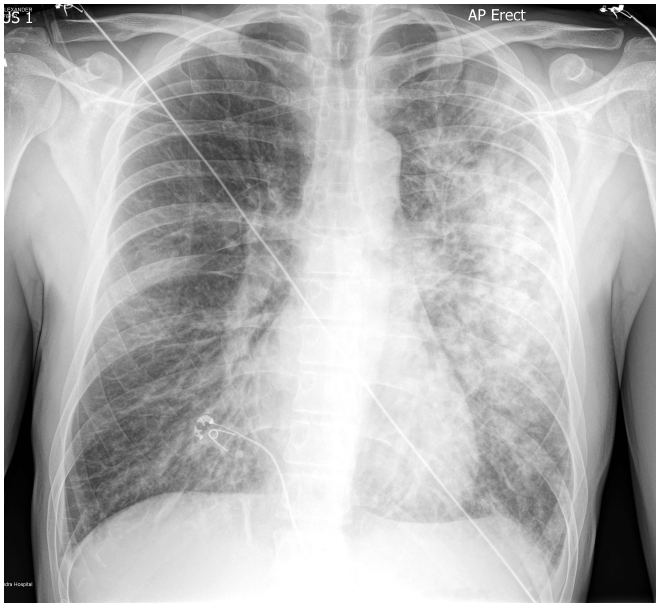
ResponseLeft midzone opacities (Confluence, suggesting alveolar infiltrates)
Right mid zone opacification obliterating right cardiac silhouette
Kerley B lines (Best seen in R lung fields)
Small left effusion
DDx
CAP
Cardiac failure
Gas:
Respiratory acidosis
HAGMA ( gap due to lactic acidosis due to cellular hypoperfusion)
Raised Aa Gradient - significant shunt as many alveoli are not oxygenated - implies severe gas exchange problem.
Right mid zone opacification obliterating right cardiac silhouette
Kerley B lines (Best seen in R lung fields)
Small left effusion
DDx
CAP
Cardiac failure
Gas:
Respiratory acidosis
HAGMA ( gap due to lactic acidosis due to cellular hypoperfusion)
Raised Aa Gradient - significant shunt as many alveoli are not oxygenated - implies severe gas exchange problem.
PromptManagement of respiratory failure
ResponseCommence BiPAP with initial settings IPAP 10-15, EPAP 5-8,
FiO2 titrated to saturations of 88-92%
Titrate NIV to WOB, improved CO2 clearance, minute ventilation
Antibiotics - empiric cover for severe CAP
Steroids - Hydrocortisone 4mg/kg
Fluids - IV N/S 10 mg/kg + repeat aim HR <100
Bronchodilators - Salbutamol 5mg + ipratropium 500 mics in line with NIV to aim resolution of wheeze
FiO2 titrated to saturations of 88-92%
Titrate NIV to WOB, improved CO2 clearance, minute ventilation
Antibiotics - empiric cover for severe CAP
Steroids - Hydrocortisone 4mg/kg
Fluids - IV N/S 10 mg/kg + repeat aim HR <100
Bronchodilators - Salbutamol 5mg + ipratropium 500 mics in line with NIV to aim resolution of wheeze
PromptIntubation approach
ResponseFluid load aiming SBP >100 prior to induction
Augmentin induction agent - Ketamine 0.5-1mg/kg, roc 1.2 mg/kg
Coadministration of inotrope at induction - 1 mic/kg adrenaline with induction
Optimise pre-oxygenation with ongoing NRBM 15L plus 15L/min NP O2 throughout induction
Mitigate hypoxia/acidosis by bagging through induction with BVM O2 15L/min
Intubate at 30 degrees to minimise risk of hypoxia
Augmentin induction agent - Ketamine 0.5-1mg/kg, roc 1.2 mg/kg
Coadministration of inotrope at induction - 1 mic/kg adrenaline with induction
Optimise pre-oxygenation with ongoing NRBM 15L plus 15L/min NP O2 throughout induction
Mitigate hypoxia/acidosis by bagging through induction with BVM O2 15L/min
Intubate at 30 degrees to minimise risk of hypoxia
PromptCauses of Noncardiogenic APO
ResponseNOT CARDIAC
Near drowning
Oxygen therapy
Transfusion/Trauma
CNS disorder
Aspiration, Altitude sickness
Renal disorder
Drugs
Inhaled toxins
Allergic Alveolitis
Contrast/Contusion
Near drowning
Oxygen therapy
Transfusion/Trauma
CNS disorder
Aspiration, Altitude sickness
Renal disorder
Drugs
Inhaled toxins
Allergic Alveolitis
Contrast/Contusion
bilateral opacities consistent with pulmonary edema XR or CT
PF ratio <300mmHg with a minimum of 5 cmH20 PEEP (or CPAP)
Not be fully explained by cardiac failure or fluid overload