RESPIRATORY
NON-PREGNANT PE
PromptList the components of PE rule out criteria (PERC)
ResponseHAD CLOTS
Hormones (Exogenous Oestrogen)
Age >= 50
DVT/PE history
Coughing blood (Haemoptysis)
Leg swelling - unilateral
O2 <95% (RA sats)
Tachycardia >=100
Surgery
False negative = 3%
Hormones (Exogenous Oestrogen)
Age >= 50
DVT/PE history
Coughing blood (Haemoptysis)
Leg swelling - unilateral
O2 <95% (RA sats)
Tachycardia >=100
Surgery
False negative = 3%
PromptYEARS Criteria in PE
ResponseSigns and symptoms of DVT
Haemoptysis
PE most likely Dx
If no to ALL then D dimer cutoff is >1.0
If yes to ANY then normal D dimer cutoff.
Haemoptysis
PE most likely Dx
If no to ALL then D dimer cutoff is >1.0
If yes to ANY then normal D dimer cutoff.
PromptD-Dimer utility in PE
ResponseMust be used with scoring system - can only use if pretest probability is low - WELLS Score
PromptCauses of false negative D dimer
ResponseSmall clot load (eg: Below knee DVT)
Mature thrombus
Defective native fibrinolysis (Which also can contribute to thrombus formation initially)
Immediately post injury (ie: no time for D dimer to form)
Mature thrombus
Defective native fibrinolysis (Which also can contribute to thrombus formation initially)
Immediately post injury (ie: no time for D dimer to form)
PromptWells score
Response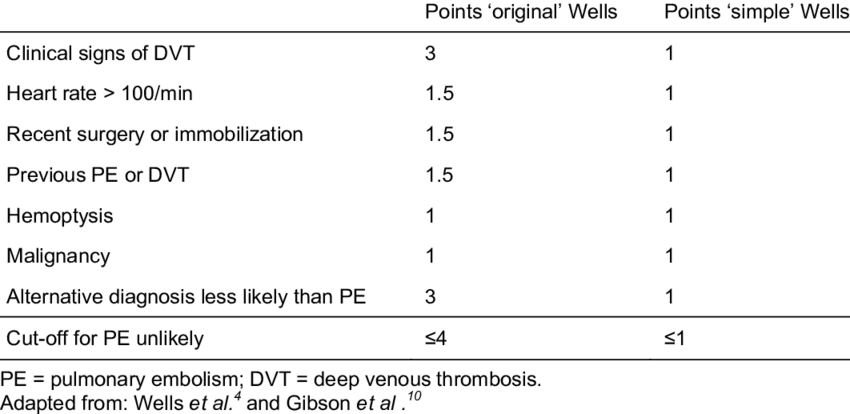
1 or less - D dimer, 2-6 = High sensitivity D dimer, >6 = CTPA
1 or less - D dimer, 2-6 = High sensitivity D dimer, >6 = CTPA
PromptCTPA Pros/cons
ResponsePro:
Widely available, quick,
Excludes some other pathologic causes for symptoms
Gives some information about complications (RV strain, pulmonary infarct)
Cons
Risk of contrast nephropathy
Contrast allergy
Deterioration in CT scanner
Radiation exposure not that relevant if old, young female of reproductive age/pregant = bad
Positive scan = filling deficits in major pulmonary vessels
Widely available, quick,
Excludes some other pathologic causes for symptoms
Gives some information about complications (RV strain, pulmonary infarct)
Cons
Risk of contrast nephropathy
Contrast allergy
Deterioration in CT scanner
Radiation exposure not that relevant if old, young female of reproductive age/pregant = bad
Positive scan = filling deficits in major pulmonary vessels
Prompt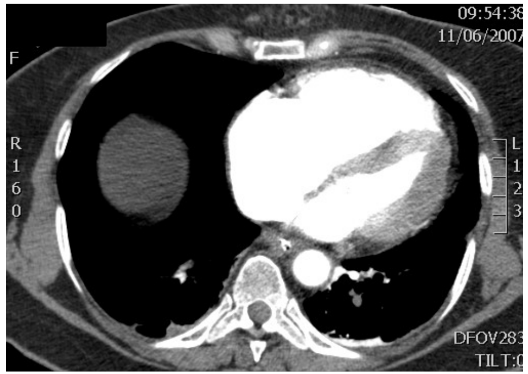
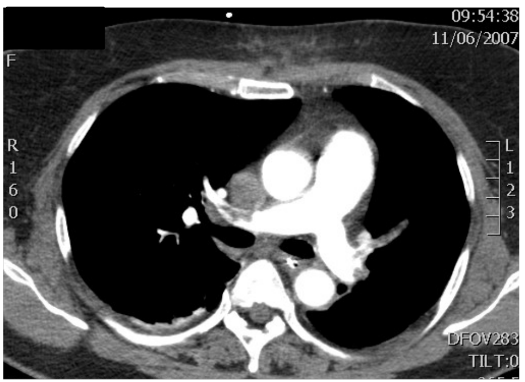
ResponseBilateral proximal pulmonary emboli
Dilated pulmonary trunk
RV>LV
LV septum flattened.
Dilated pulmonary trunk
RV>LV
LV septum flattened.
Prompt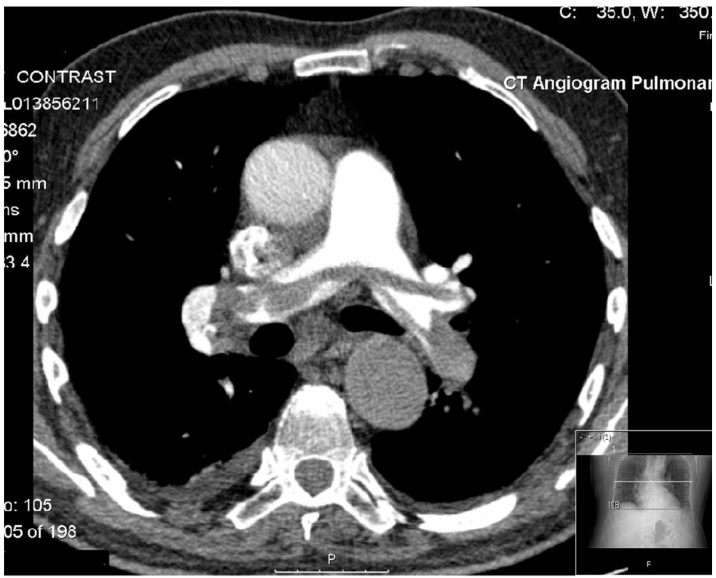
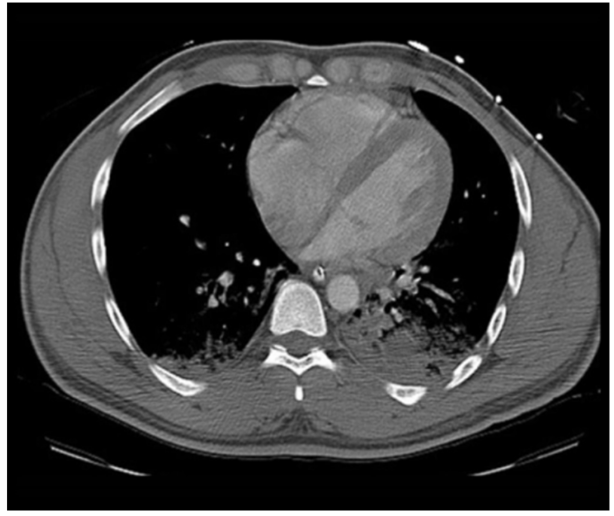
ResponseSaddle embolus
R atrial dilation
Bilateral consolidation/collapse not specific for PE so not accepted (Question didn’t specify specific to PE but also it was about diagnosing a PE in a pregnancy lady so i guess thats fair)
R atrial dilation
Bilateral consolidation/collapse not specific for PE so not accepted (Question didn’t specify specific to PE but also it was about diagnosing a PE in a pregnancy lady so i guess thats fair)
PromptVQ scan
ResponsePro: lower radiation dose (Especially with perfusion only scan), similar sensitivity to CTPA for mod-large PE. Compare with previous VQ scans. Identifies large perfusion deficit
Con: Delay in obtaining scan, interpretation difficult in old lungs - indeterminate result, false positive in existing lung disease, Doesn’t diagnose alternate pathology
Positive scan = unmatched perfusion defects
Con: Delay in obtaining scan, interpretation difficult in old lungs - indeterminate result, false positive in existing lung disease, Doesn’t diagnose alternate pathology
Positive scan = unmatched perfusion defects
PromptMRI Angiogram
ResponseOK for picking big PE’s in major vessels, may be an option for pregnant women if stable
PromptDuplex US legs
ResponseNo radiation, useful in patients with contraindication to radiation,
Not diagnostic of PE
Not diagnostic of PE
PromptECG findings in PE
Note one question asked for 8 ECG findings in PE - Yikes!
Note one question asked for 8 ECG findings in PE - Yikes!
ResponseRight ventricular strain pattern - Simultaneous T wave inversion in the inferior (II, III, aVF) and right precordial leads (V1-V4) is the most specific finding (99% in one study. Associated with hith pulmonary artery pressures.
Sinus tachy - most commonly seen (44%)
RBBB (Complete or incomplete, ~18%)
Right axis deviation (~16%) (Ironically can also have LAD)
Dominant R wave in V1
R atrial enlargement - “P pulmonale” - peaked P waves in lead II>2.5mm
S1Q3T3 - Deep S in I, Q in III, TWI in III. not sensitive, nor specific, ~20% of PE’s. (Classic finding though)
Atrial arrhythmia
Non specific ST-T wave changes
Clockwise rotation
NSYD 2019.2-9 for more detail. This was summarised
Sinus tachy - most commonly seen (44%)
RBBB (Complete or incomplete, ~18%)
Right axis deviation (~16%) (Ironically can also have LAD)
Dominant R wave in V1
R atrial enlargement - “P pulmonale” - peaked P waves in lead II>2.5mm
S1Q3T3 - Deep S in I, Q in III, TWI in III. not sensitive, nor specific, ~20% of PE’s. (Classic finding though)
Atrial arrhythmia
Non specific ST-T wave changes
Clockwise rotation
NSYD 2019.2-9 for more detail. This was summarised
PromptI’ve flipped this one round!
Sinus tachy 100-110
RBBB RSR V1
RAD
S1Q3T3
RV strain - ST Depression V1+V2
Sinus tachy 100-110
RBBB RSR V1
RAD
S1Q3T3
RV strain - ST Depression V1+V2
ResponseDescribe ECG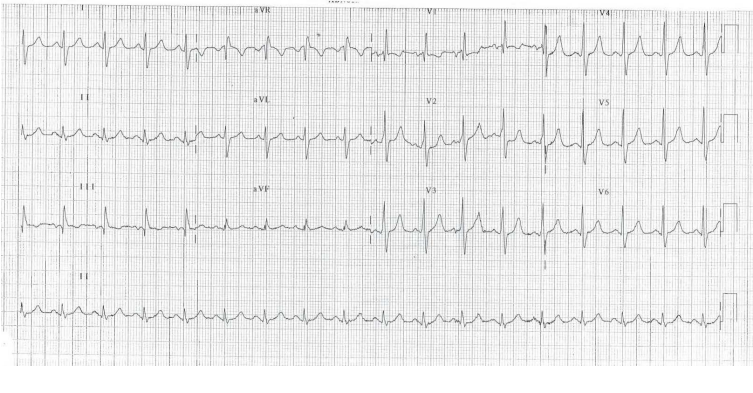
PromptSR 75
RAD
RBBB
S1Q3T3
Deep TWI precordial leads V1-V4, III, Flat AVF
RAD
RBBB
S1Q3T3
Deep TWI precordial leads V1-V4, III, Flat AVF
ResponseDescribe ECG 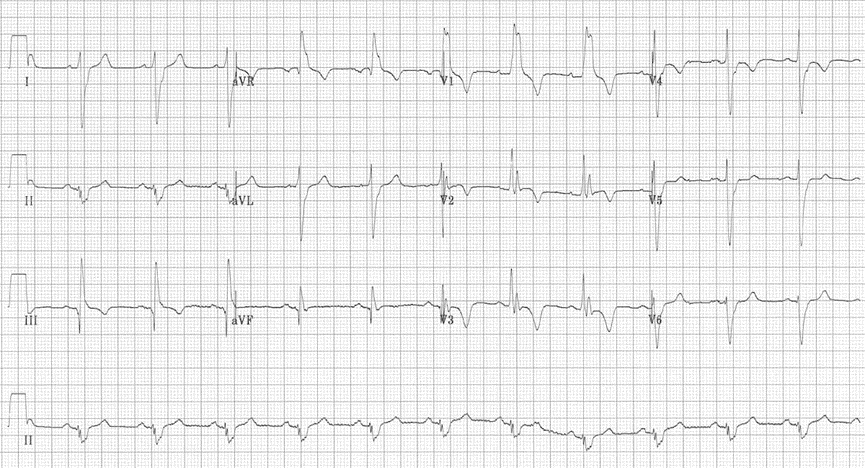
PromptPros/Cons of Echo in PE
Note a lot of questions are TTE or TOE - suggest you define which if asked.
Note a lot of questions are TTE or TOE - suggest you define which if asked.
ResponsePro: Bedside test - provisional Dx in shocked pt who can’t go to scanner, R heart strain assessed, no radiation
Con: Operator dependent, less helpful in segmental/small PE. rarely provides direct evidence of clot
Con: Operator dependent, less helpful in segmental/small PE. rarely provides direct evidence of clot
PromptUltrasound findings of PE
ResponseRV strain:
Hyperdynamic LV
Dilated IVC with lack of respiratory collapse
- Dilated RV (larger than LV)
- septal flattening (D Sign)
- Poorly contractile RV
- Reduced TAPSE <1.6cm
- High RV pressures, high pulmonary arterial pressures
- RA enlargement
- Tricuspid regurgiation
- McConnell sign Echocardiographic pattern of RV dysfunction consisting of akinesia of the mid free wall but normal motion at the apex - 77% sensitivity and 94% specificity for diagnosis of pulmonary embolism - LIFTL Jun 24
Hyperdynamic LV
Dilated IVC with lack of respiratory collapse
PromptRV dilation - Ratio of RV/LV end diastolic area >1
RV dilation - septal flattening (D sign)
Paradoxical septal wall motion
RV free wall hyperkinesis and systolic dysfunction
Small LV size
Dx = massive PE
RV dilation - septal flattening (D sign)
Paradoxical septal wall motion
RV free wall hyperkinesis and systolic dysfunction
Small LV size
Dx = massive PE
Response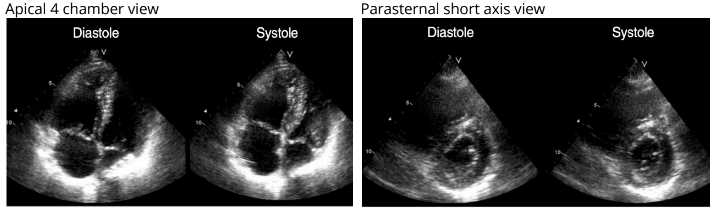
PromptCXR findings in PE
ResponseWestermarks sign, hamptons hump, pulmonary infarct
PromptOther investigations in PE
ResponseProthrombotic screeen - identify underlying cause
Troponin - Prognostic significance
Platelets (if starting heparin)
US legs - identify clot burdon
Troponin - Prognostic significance
Platelets (if starting heparin)
US legs - identify clot burdon
PromptPE management (Hypotensive)
ResponseImprove oxygenation: HFNP 50L titrated to sats of 92-96%
Vasopressors - noradrenaline target BP 90-100
Systemic thrombolysis with dose
Vasopressors - noradrenaline target BP 90-100
Systemic thrombolysis with dose
PromptSystemic thrombolysis Doses
ResponseAlteplase
- Stable - alteplase 100 mg - 10 mg bolus then 90 mg over 2 hours (If >65kg)
- Deteriortating/arrests - 50 mg alteplase bolus
PromptPE mgmt in patient with prior brain bleed
ResponseIV fluid bolus aim SBP >100 >> central access and vasopressor (Norad) if poorly responsive
Bedside echo - elevated RV pressure or deviation of interventricular septum suggestive of increased RV pressure
Chase history of brain bleed/surgery
D/W Cardiothoracics suitability of surgical embolectomy
Discussion of treatment options - Thrombolysis with tenecteplase if RV pressure high vs anticoagulation if RV pressure normal
If arrests - thrombolysis
Bedside echo - elevated RV pressure or deviation of interventricular septum suggestive of increased RV pressure
Chase history of brain bleed/surgery
D/W Cardiothoracics suitability of surgical embolectomy
Discussion of treatment options - Thrombolysis with tenecteplase if RV pressure high vs anticoagulation if RV pressure normal
If arrests - thrombolysis
PromptManagement of small PE
ResponseHeparin, Rivaroxaban 15 mg BD x 3 weeks then 20 mg daily
PromptDefinitive management options for large PE
ResponseThrombolytics
- Massive PE with haemodynamic compromise, or dealy to alternate therapy
- CI - the usual contraindications for thrombolytics
- Alteplase 100 mg over 2 hours (if unstable give first 20 mg as bolus)
- Massive PE with haemodynamic compromise and access to cardiothoracics
- CI - no timelay access to CTx surgery
- Access ro IR, ability to lie flat (often need to be intubated)
- CI - contrast allergy (Might have had CTPA in stem…. So not great marks) renal failure (relative), no access to IR
PromptIndications for thrombolysis in PE
ResponseGenerally accepted:
Cardiac arrest - CPR will need to be prolonged
Massive PE - hypotension, Systolic < 90 for >15 mins
More controversial:
R heart strain on echo or positive cardiac enzymes (PEITHOS study)
Extensive clot burden - Moderate PE (R + L main pulmonary trunks or >2 lobes with 70% involvement - MOPPETT study)
Severe or worsening RV function “submassive PE”
Worsening despite anticoagulation
Severe hypoxia
The use of thrombolysis for massive PE is widely accepted as the standard of care. This has been shown to reduce mortality and PE recurrence compared to anticoagulation alone. The controversial bit is the use of thrombolysis for submassive PE - EM CRIT
Cardiac arrest - CPR will need to be prolonged
Massive PE - hypotension, Systolic < 90 for >15 mins
More controversial:
R heart strain on echo or positive cardiac enzymes (PEITHOS study)
Extensive clot burden - Moderate PE (R + L main pulmonary trunks or >2 lobes with 70% involvement - MOPPETT study)
Severe or worsening RV function “submassive PE”
Worsening despite anticoagulation
Severe hypoxia
The use of thrombolysis for massive PE is widely accepted as the standard of care. This has been shown to reduce mortality and PE recurrence compared to anticoagulation alone. The controversial bit is the use of thrombolysis for submassive PE - EM CRIT
PromptName trials investigating thrombolysis in submassive PE
ResponseMOPETT
PEITHOS
PEITHOS
PromptPros and cons of thrombolysis
ResponsePros: rapidly reduce clot burden to reduce RV strain, improving haemodynamics. Reduce long term pulmonary hypertension, Mortality benefit in massive PE
Cons: ICH/other bleed, Cost
Cons: ICH/other bleed, Cost
PromptABSOLUTE Contraindications for thrombolysis in PE
ResponseABSOLUTE (Basically anything in the skull)
Previous ICH
Structural intracranial disease
Ischaemic stroke <3 months
Recent brain/spinal surgery
Recent head trauma with fracture or brain injury
Active bleeding
Previous ICH
Structural intracranial disease
Ischaemic stroke <3 months
Recent brain/spinal surgery
Recent head trauma with fracture or brain injury
Active bleeding
PromptRELATIVE contraindications for thrombolysis in PE
ResponseTraumatic CPR <10 days
Recent bleeding - Marjor <6 months, Minor <10 days
Recent surgery <3 months, or invasive procedure
Ischaemic stroke >3 months previously
GI ulceration/varices within <3 months
Malignancy with bleeding risk
Anticoagulation prior to presentation, Bleeding disorder, low platelets
Diabetic retinopathy
Pregnancy
endocarditis/pericarditis/pericardial effusion
Pancreatitis
Age >75, body weight <60
BP>180/110
Recent bleeding - Marjor <6 months, Minor <10 days
Recent surgery <3 months, or invasive procedure
Ischaemic stroke >3 months previously
GI ulceration/varices within <3 months
Malignancy with bleeding risk
Anticoagulation prior to presentation, Bleeding disorder, low platelets
Diabetic retinopathy
Pregnancy
endocarditis/pericarditis/pericardial effusion
Pancreatitis
Age >75, body weight <60
BP>180/110
PromptPulmonary Embolsus Severity Index
(name 5/11 criteria)
(name 5/11 criteria)
ResponseMemory aid: Name bad obs + heart/lung disease gets you most of the points
Age
Sex M>F
Hx cancer
Hx CCF
Hx Chronic lung disease
HR >110
SBP <100
RR >30
T <36
Altered mental status
O2 saturation <90%
Age
Sex M>F
Hx cancer
Hx CCF
Hx Chronic lung disease
HR >110
SBP <100
RR >30
T <36
Altered mental status
O2 saturation <90%