PAEDIATRICS
CONGENITAL HEART DISEASE
PromptNormal Neonatal ECG features
ResponseRight axis
Dominant R wave across chest leads
T wave inversion across anterior chest leads
Faster HR, shorter intervals
Dominant R wave across chest leads
T wave inversion across anterior chest leads
Faster HR, shorter intervals
PromptSigns suspicious for duct dependent lesion
ResponseCyanosis/hypoxia
Hyperoxia test - failing to increase SaO2 (although not recommended anymore)
No femoral pulses
Hepatomegaly
Murmur
Hyperoxia test - failing to increase SaO2 (although not recommended anymore)
No femoral pulses
Hepatomegaly
Murmur
PromptDuct dependent congenital heart disease
ResponseDuct dependent systemic circulation - (Acyanotic) Shock/Met Acidosis, L heart failure
1 - truncus arteriosus (1 vessel)
2 - Transposition of great vessels (2 vessels)
3 - Tricuspid atresia (tri = 3)
4 - tetralogy of Fallot (tet = 4)
5 - Total anomalous pulmonary venous return (5 words)
- Coarctation (absent femoral pulses)
- Critical Aortic stenosis
- Mitral atresia
- Hypoplastic left heart syndrome
- Pulmonary atresia
- Severe pulmonary stenosis
- Tricuspid atresia
- Transposition of the great vessels
1 - truncus arteriosus (1 vessel)
2 - Transposition of great vessels (2 vessels)
3 - Tricuspid atresia (tri = 3)
4 - tetralogy of Fallot (tet = 4)
5 - Total anomalous pulmonary venous return (5 words)
PromptNon duct dependent congenital heart disease
ResponseTruncus arteriosus
Total anomalous pulmonary venous drainage
ASD
VSD
Tetralogy of Felot
Total anomalous pulmonary venous drainage
ASD
VSD
Tetralogy of Felot
PromptTreatment of duct dependent lesion
ResponseProstaglandin E1 Infusion
50 ng/kg/min - increase to 100ng/kg/min if require (This is a large dose to reopen duct in shock)
Adverse - Apnoea, hypotension, hypoglycaemia, transient hypothermia
50 ng/kg/min - increase to 100ng/kg/min if require (This is a large dose to reopen duct in shock)
Adverse - Apnoea, hypotension, hypoglycaemia, transient hypothermia
PromptHistory favouring cardiac vs respiratory illness
ResponseHistory:
Poor weight gain/failure to thrive
Prolonged feeding time
Sweating with feeds
Episodes of cyanosis associated with effort
Examination:
Grunting, effortless tachypnoea in absence of URTI
Clear lung fields (May have Pulmonary oedema though)
Murmur/abnormal heart sounds
Heapatomegaly +/- pulsatile
Poor weight gain/failure to thrive
Prolonged feeding time
Sweating with feeds
Episodes of cyanosis associated with effort
Examination:
Grunting, effortless tachypnoea in absence of URTI
Clear lung fields (May have Pulmonary oedema though)
Murmur/abnormal heart sounds
Heapatomegaly +/- pulsatile
PromptCXR findings
ResponseR cardiac obstructive lesion - Clear black lung fields (not much lung marking)
L to R shunging - cardiomegaly.
Specific findings for certain condition.
L to R shunging - cardiomegaly.
Specific findings for certain condition.
Prompt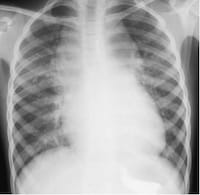
ResponseTotal anomalous pulmonary venous return: “Snowman”
Prompt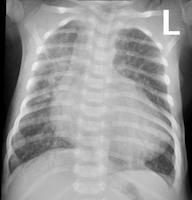
ResponseTransposition of the Great Arteries: “Egg on a string”
Prompt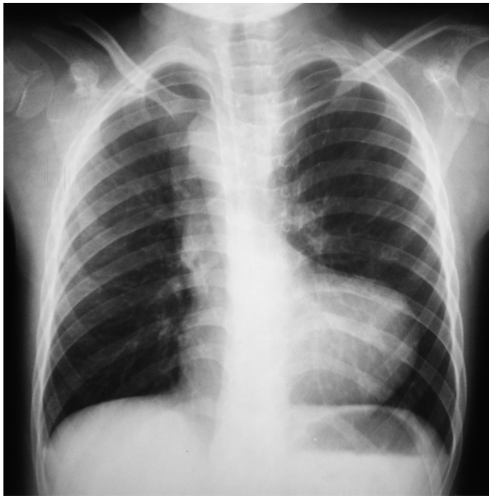
ResponseBoot shaped heart with an upturned cardiac apex due to RVH and concave pulmonary arterial segment
Oligaemic lung fields (due to decreased pulmonary arterial flow)
= Tetralogy of Fallot
Note the XR here is from practice questions, above 2 from internet. Good spot Diagnosis
Oligaemic lung fields (due to decreased pulmonary arterial flow)
= Tetralogy of Fallot
Note the XR here is from practice questions, above 2 from internet. Good spot Diagnosis
PromptWhat is Tetralogy of Fallot
ResponsePROVe its Tetralogy:
Pulmonary stenosis
RV hypertrophy
Overriding aorta
VSD
Pulmonary stenosis
RV hypertrophy
Overriding aorta
VSD
PromptWhat is a Tet Spell and how do you manage them
ResponseHypercyanotic (tet) spells present as periods of profound cyanosis that occur because of episodes of almost total RVOT obstruction. They typically arise when infants becomes agitate or in older, uncorrected children after vigorous exercise
Increased R -> L shunting and resullting decreased pulmonary blood flow, due to:
Sepsis/Infection
Pain response to injury
Dehydration
overexertion
Increased R -> L shunting and resullting decreased pulmonary blood flow, due to:
- Increased pulmonary vascular resistance
- Increased RV outflow obstruction
- Decreased in systemic vascular resistance (lower L heart pressure)
Sepsis/Infection
Pain response to injury
Dehydration
overexertion
PromptInitial management of a Tet Spell
ResponseGive high flow oxygen via NRB - pulmonary vasodilator/systemic vasoconstrictor. Sats may not change
Knee to chest position - increases systemic vascular resistance and increases venous return (Decrases R to L shunt)
Calm crying/distressed infants - Crying worsens pulmonary vascular resistance >> worsening R to L shunt
Knee to chest position - increases systemic vascular resistance and increases venous return (Decrases R to L shunt)
Calm crying/distressed infants - Crying worsens pulmonary vascular resistance >> worsening R to L shunt
PromptManagement of refractory Tet Spell
Responsefluid bolus 10 mL/kg N/S (Being cautious of increased distress with needles). Fluid improving RV filling in context of restrictive RV physiology
Sedate with morphine 0.1-0.2mg/kg IV/IM - mechanism unclear
Propranolol 0.2mg/kg over 5 mins
IV phenylephrine 5-20 mics/kg followed by infusion
ICU/Cardiology/Emergent surgical repair
Sedate with morphine 0.1-0.2mg/kg IV/IM - mechanism unclear
Propranolol 0.2mg/kg over 5 mins
- Relaxation of RVOT with improved pulmonary blood flow
IV phenylephrine 5-20 mics/kg followed by infusion
ICU/Cardiology/Emergent surgical repair
https://emergencymedicinecases.com/congenital-heart-disease-emergencies-2/