PAEDIATRICS
INFANT RESUSCITATION (HOURS - MONTHS)
PromptRisk factors for neonatal sepsis
ResponseMaternal GBS
Prematurity
Maternal peri-partum illness/fever/infection
PROM (>24h)
Prematurity
Maternal peri-partum illness/fever/infection
PROM (>24h)
PromptCommon pathogens for neonatal sepsis
ResponseE. Coli
Group B strep
Listeria (In textbooks but very uncommon in reality)
HSV
Group B strep
Listeria (In textbooks but very uncommon in reality)
HSV
PromptDDx Neonatal collapse
ResponseTHE MISFITS
Trauma - NAI vs accidental. Rib trauma, shaken baby, SAh, neglect with dehydration
Heart - congenital cardiac disease (duct dependant)
Endocrine - Electolyte disturbance, CAH, HYPOGLYCAEMIA
Metabolic - Inborn errors of metabolisim, mitochondrial disorder, Fatty oxidation disorder
Iatrogenic
Sepsis - meningitis/pneumonia, Group B Strep bacteraemia
Feeding problems - formula dilution vs overconcentration
Intestinal emergencies
Toxins - NAI, Botulism/food poisoning
Seizures
Trauma - NAI vs accidental. Rib trauma, shaken baby, SAh, neglect with dehydration
Heart - congenital cardiac disease (duct dependant)
Endocrine - Electolyte disturbance, CAH, HYPOGLYCAEMIA
Metabolic - Inborn errors of metabolisim, mitochondrial disorder, Fatty oxidation disorder
Iatrogenic
Sepsis - meningitis/pneumonia, Group B Strep bacteraemia
Feeding problems - formula dilution vs overconcentration
Intestinal emergencies
Toxins - NAI, Botulism/food poisoning
Seizures
PromptManagement Priorities of neonatal collapse
ResponseEarly recognition/seeking senior help
Assess airway and breathing and administer oxygen if required
Empiric antibiotic therapy
Source control
Hypoglycaemia
Above from RCH as better than answer, modified with more detail
Bloods for cultures - VBG, BSL, FBC, Lactate
Full history and examination
LP (Can be delayed)
Explanation to carer
Above leftover from original answers
Assess airway and breathing and administer oxygen if required
- Conscious - 15L via NRB >> HFNC 2L/kg, CPAP, BIPAP
- Unconscious - ? ETT
Empiric antibiotic therapy
- Benpen 60 mg/kg + cefotaxime 50 mg/kg
- Aciclovir 20 mg/kg IV if concerns for HSV encephalitis
- 20 mL/kg N/S + repeat after fluid status assessment being aware of overload
- If fails after 40 mL/kg reconsider diagnosis and treatment
- Adrenaline 6mg in 1000 mL - start at 0.5 mL/kg/hr (=0.05 mics/kg/min)
Source control
Hypoglycaemia
- BSL check + Correct - 2 mL/kg 10% dextrose
- Prostaglandin infusion
- Hydrocortisone 25mg IV/IM
Above from RCH as better than answer, modified with more detail
Bloods for cultures - VBG, BSL, FBC, Lactate
Full history and examination
LP (Can be delayed)
Explanation to carer
Above leftover from original answers
PromptManagement components of INFANT with HR 50, GCS 3
ResponseCommence CPR 15:2 – 2 rescuers, 100/min
Apply 100% O2 via BVM / intubate OK
IV access and fluid bolus O.9% saline 20ml/kg (or similar) (200ml)
IV adrenaline 10mcg/kg (12 month old approx. 10kg – accept 100mcg)
Seek and treat hypoglycaemia with IV 5ml/kg 10% dextrose (ie 50ml 10%)
IV antibiotics OK – ceftriaxone / cefotaxime – 50-100/kg
Apply 100% O2 via BVM / intubate OK
IV access and fluid bolus O.9% saline 20ml/kg (or similar) (200ml)
IV adrenaline 10mcg/kg (12 month old approx. 10kg – accept 100mcg)
Seek and treat hypoglycaemia with IV 5ml/kg 10% dextrose (ie 50ml 10%)
IV antibiotics OK – ceftriaxone / cefotaxime – 50-100/kg
PromptALS for infants and children
ResponseThere are 4 differences to adults (pretty much doses not anything else)
Ratio 15:2 (<8 years old or some references puberty)
Shock is 4 J/kg
Adrenaline is 10 mics/kg
Shockable after 2nd shock then every 2nd loop
Non shockable immediately then every 2nd loop
Amiodarone 5mg/kg after 3rd shock (shockable rhythms)
10% glucose 2 mL/kg (Some say 5 mL/kg)
Ratio 15:2 (<8 years old or some references puberty)
Shock is 4 J/kg
Adrenaline is 10 mics/kg
Shockable after 2nd shock then every 2nd loop
Non shockable immediately then every 2nd loop
Amiodarone 5mg/kg after 3rd shock (shockable rhythms)
10% glucose 2 mL/kg (Some say 5 mL/kg)
PromptFill in blank boxes on PALS chart…. Have just left full chart here
Response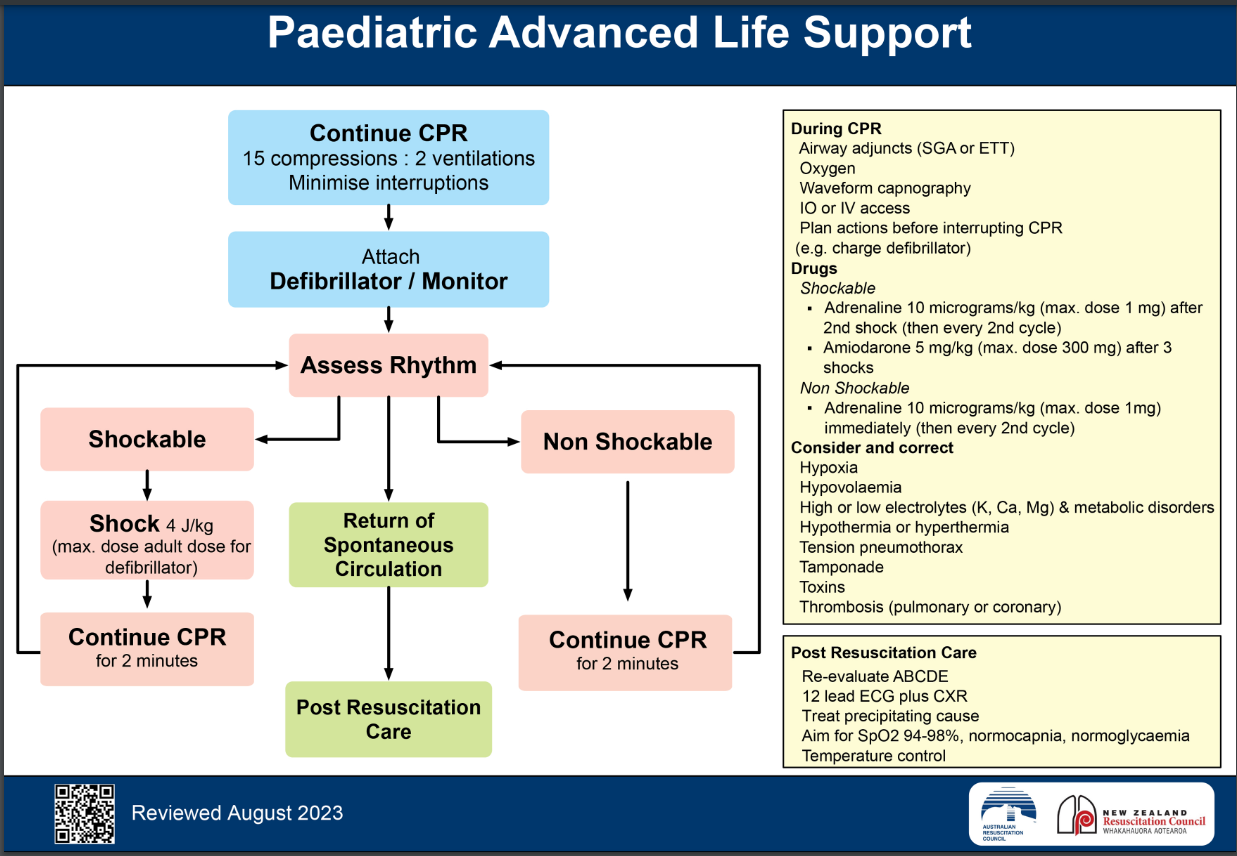
PromptRationale for different ratio in CPR
ResponseYounger population more likely to have asphyxia as cause of arrest so increased emphasis on ventilation (A/B) vs compressions ©
Note BLS (as in st. John ambulance etc) says 30:2 for everyone to reduce confusion and increase bystander CPR attempts
Note BLS (as in st. John ambulance etc) says 30:2 for everyone to reduce confusion and increase bystander CPR attempts
PromptTube size and depth in term neonate
ResponseAnswer I’m going with: 3.0-3.5 Cuffed
There are a LOT of conflicting things on this - Have seen anything from 2.5-3.5 cuffed, 3.0-4.0 uncuffed for newborn and no clear consensus.
UNCUFFED = Gestational age/10 (ie: 25 weeks =2.5, 40 wks =4.0)
CUFFED = UNCUFFED size -0.5. - Start with 3.5 cuffed
RCH:
Size of cuffed ETT (internal diameter in mm) = Age/4 + 3.5
Tubes of the size calculated above, plus tube 0.5 mm ID smaller and 0.5 mm ID larger, should all be available on the child's bed.
Depth = 10cm (oral), 12cm (nasal) in term neonate
Formulas: weight (kg) + 6, ETT size x3, 12+ Age/2
There are a LOT of conflicting things on this - Have seen anything from 2.5-3.5 cuffed, 3.0-4.0 uncuffed for newborn and no clear consensus.
UNCUFFED = Gestational age/10 (ie: 25 weeks =2.5, 40 wks =4.0)
CUFFED = UNCUFFED size -0.5. - Start with 3.5 cuffed
RCH:
Size of cuffed ETT (internal diameter in mm) = Age/4 + 3.5
Tubes of the size calculated above, plus tube 0.5 mm ID smaller and 0.5 mm ID larger, should all be available on the child's bed.
Depth = 10cm (oral), 12cm (nasal) in term neonate
Formulas: weight (kg) + 6, ETT size x3, 12+ Age/2
PromptCuffed or uncuffed tube
ResponseHistorically uncuffed tubes were preferred
Narrowest part of paediatric airway is subglottic
Older paediatric ETT’s had small volume, high pressure cuffs made of poorly tolerated material leading to tracheal injury and subsequent subglottic stenosis
Newer devices have large volume, lower pressure cuffs and don’t tend to cause this
Narrowest part of paediatric airway is subglottic
Older paediatric ETT’s had small volume, high pressure cuffs made of poorly tolerated material leading to tracheal injury and subsequent subglottic stenosis
Newer devices have large volume, lower pressure cuffs and don’t tend to cause this
PromptList Intubation equipment you would prepare for an infant
ResponseBVM/Neopuff
Miller 1 blade
ETT size 3.5 cuffed
Stylette/bougie
LMA size 1
Capnography, ECG, Pulsoxymetry
Laryngoscope 1+2 Miller
Ventilator (Paediatric appropriate)
Suction catheter
Oropharyngeal/nasopharyngeal
Miller 1 blade
ETT size 3.5 cuffed
Stylette/bougie
LMA size 1
Capnography, ECG, Pulsoxymetry
Laryngoscope 1+2 Miller
Ventilator (Paediatric appropriate)
Suction catheter
Oropharyngeal/nasopharyngeal
PromptInfant resuscitation drug doses
ResponseInduction
Sux 1-2mg/kg
Midaz 0.15 mg/kg
Fentanyl 2-3 mic/kg (may cause chest wall rigidity)
Morphine 0.2mg/kg
Ketamine 1-2 mg/kg
Propofol 1mg/kg
Thiopentone 1mg/kg (2-5 mg/kg)
Rescue
Atropine 20 mics/kg
Sux 1-2mg/kg
Midaz 0.15 mg/kg
Fentanyl 2-3 mic/kg (may cause chest wall rigidity)
Morphine 0.2mg/kg
Ketamine 1-2 mg/kg
Propofol 1mg/kg
Thiopentone 1mg/kg (2-5 mg/kg)
Rescue
Atropine 20 mics/kg
PromptVent settings
ResponseTV 6-8 mL/kg
RR 40
FiO2 titrated to saturations 95-98%
RR 40
FiO2 titrated to saturations 95-98%
PromptInfant resuscitation
ResponseANZCOR suggests that in infants and children who are unresponsive and not breathing normally, healthcare providers should begin CPR unless they can definitely palpate a pulse within 10 seconds
CPR 15:2 rate 100/min
Apply 100% O2 via BVM (+ intubate?)
IV access and fluid bolus 20 mL/kg N/S (10 mL/kg + repeat to 40 mL/kg - APLS)
IV adrenaline 10 mics/kg
Seek and treat hypoglycaemia - IV 10% dextrose 5mL/kg
IV antibiotics
CPR 15:2 rate 100/min
Apply 100% O2 via BVM (+ intubate?)
IV access and fluid bolus 20 mL/kg N/S (10 mL/kg + repeat to 40 mL/kg - APLS)
IV adrenaline 10 mics/kg
Seek and treat hypoglycaemia - IV 10% dextrose 5mL/kg
IV antibiotics
PromptH’s and T’s
ResponseHypoxia
Hypovolaemia
Hyper/hypokalaemia
Hypothermia
HYPOGLYCAEMIA - not really but worth checking
Tamponade
Tension pneumothorax
Thrombus (Cardiac/Pulmonary)
Toxin
Hypovolaemia
Hyper/hypokalaemia
Hypothermia
HYPOGLYCAEMIA - not really but worth checking
Tamponade
Tension pneumothorax
Thrombus (Cardiac/Pulmonary)
Toxin
PromptParental presence during resus pros/cons
ResponseAllows parents to see all treatment being provided
In case of unsuccessful resuscitation allows initiation of grieving process
Can worsen staff grief around events of highly emotive resus
Potential for interference with resuscitation from parents unless dedicated staff member caring for patient (then one less in resus)
In case of unsuccessful resuscitation allows initiation of grieving process
Can worsen staff grief around events of highly emotive resus
Potential for interference with resuscitation from parents unless dedicated staff member caring for patient (then one less in resus)