TRAUMA - ADULT
BURNS
PromptList the 4 different burns depths
ResponseEpidermal
Superficial dermal
Mid dermal
Deep dermal
Full thickness
Superficial dermal
Mid dermal
Deep dermal
Full thickness
PromptCharacteristics fo deep thickness burns
ResponseInvolves entire epidermis and dermis
Non-blanching/no cap refil
Charred, pale, leathery
Painless
Non-blanching/no cap refil
Charred, pale, leathery
Painless
PromptComplications of exposure to smoke
ResponseUpper airway burns – visible airway oedema, stridor
Pneumonitis/inhalational lung injury – bronchospasm, carbonaceous sputum, soot in mouth, facial burns
Carbon monoxide poisoning – cns signs, elevated carboxyhaemoglobin level
Cyanide toxicity – lactate >10 without severe burns
Pneumonitis/inhalational lung injury – bronchospasm, carbonaceous sputum, soot in mouth, facial burns
Carbon monoxide poisoning – cns signs, elevated carboxyhaemoglobin level
Cyanide toxicity – lactate >10 without severe burns
PromptManagement and resuscitation of severe burns patient
ResponseFluid Management
- Parklands Formula 3ml x TBSA% X Weight = 8400ml
- Hartmann's 4.2L in first 8 hours then remaining 4.2L over next 16hrs
- Aim map 65 (normotension), UO >0.5-1 ml/kg/hr. Monitor lactate and base excess
- IDC
- Morphine 5-10mg IV every 5min titrated to pain
- Ketamine 10-20mg IV incremental doses as adjunct Regular paracetamol 1g QID and NSAID.
- Central (catheter if available) - Aim normothermia
- Warm fluids, Bair hugger/space blanket, towel around head
- Change wet linen
- Wrap burns in cling film or impregnated gauze/crepe.
- Organise transfer to major burns referral Centre
PromptList 5 findings suggesting airway threatening burn
ResponseStridor
Loss of voice/Hoarse voice/Odynophagia
Marked Lip swelling
Obvious oral cavity/oropharyngeal swelling
Burnt nasal hair
Carbonaceous sputum
History of fire in a confined space
Loss of voice/Hoarse voice/Odynophagia
Marked Lip swelling
Obvious oral cavity/oropharyngeal swelling
Burnt nasal hair
Carbonaceous sputum
History of fire in a confined space
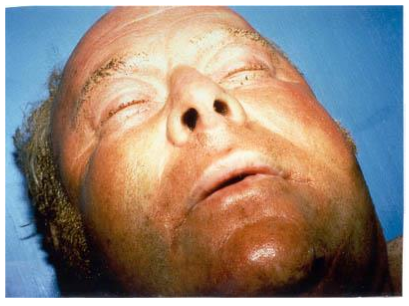
Prompt55M, BBQ explosion. (Steaks now well done)
Concerning signs and symptoms to look for
Concerning signs and symptoms to look for
ResponseFacial or oral burns
Singed nasal hairs
Swollen lips
Singed eyebrows/eyelashes
Signs of other trauma
Oedema (laryngeal, facial etc.)
Tachypnoea
Wheeze
Stridor
Singed nasal hairs
Swollen lips
Singed eyebrows/eyelashes
Signs of other trauma
Oedema (laryngeal, facial etc.)
Tachypnoea
Wheeze
Stridor
PromptList investigations in above patient
ResponseCarboxyhaemoglobin level
UEC
Glucose
ABG
Creatinine Kinase
CXR
ECG
UEC
Glucose
ABG
Creatinine Kinase
CXR
ECG
PromptFluid strategy
ResponseParkland – paeds, 3-4ml/kg*TBSAburns over 24hrs, half first 8 hrs plus maintenance, Hartmanns
PromptList methods of calculating percentage burn area
ResponseRule of nines
Lund & Browder diagram
Palmar surface (?vs Area of back of patient’s hand) = 1% BSA
Lund & Browder diagram
Palmar surface (?vs Area of back of patient’s hand) = 1% BSA
Prompt
Response
PromptIndications for IV fluids in burns patient
ResponseAdult >15-20% TBSA
Children >10% TBSA
electrical burns
coexistent traumatic injuries
delayed presentation
inhalation injury
Children >10% TBSA
electrical burns
coexistent traumatic injuries
delayed presentation
inhalation injury
PromptFluid management in first 24 horus
ResponseModified Parkland Formula = Parkland’s formula estimates fluid in ml, to be given over 24 hours.
3-4mLs x TBSA% Burn X Weight (kg)
1/2 Total Fluid Volume to be given in first 8 hours post burn
1/2 Total Fluid Volume to be given over next 16 hours
Note 4mL seems more oldschool where as 3mL seems newer - Most answers use 4mL
3-4mLs x TBSA% Burn X Weight (kg)
1/2 Total Fluid Volume to be given in first 8 hours post burn
1/2 Total Fluid Volume to be given over next 16 hours
Note 4mL seems more oldschool where as 3mL seems newer - Most answers use 4mL
Prompt80 kg patient. 10 % deep thermal burns. Calculate fluids in first 8 hours.
ResponseTotal fluid based on Parkland formula (Hartmann’s solution) = 4ml x 80kg x 10% = 3.2 L fluid.
Therefore, give 1.6 L over first 8 hours.
Therefore, give 1.6 L over first 8 hours.
Prompt100 kg, Deep burns both upper limbs and anterior trunk. Calculate BSA and fluids
Response36%
Parkland formula – 4ml/kg * %BSA
4 * 36 * 100 = 14400 mL
Administration principle: Half over first 8hrs, half over next 16hrs
Parkland formula – 4ml/kg * %BSA
4 * 36 * 100 = 14400 mL
Administration principle: Half over first 8hrs, half over next 16hrs
Prompt100 kg, full thickness RUL and anterior chest burns. Calculate BSA and fluid RATE
Response18% (rule of 9s)
Total fluid in first 24 hr = (18 x 100 x 4) ml, or 7200 ml
Half should be given over first 8 hours - Ie, (18 x 100 x 4)/2 ml, or 3600 ml
Initial rate = (18 x 100 x 4) / (2 x 8) ml/hr, or 450 ml/hr
Half should be given over subsequent 16 hours
Rate after 8 hours = (18 x 100 x 4) / (2 x 16) ml/hr, or 225 ml/hr
Fluid choice = crystalloids, such as N Saline or Hartmann’s
Total fluid in first 24 hr = (18 x 100 x 4) ml, or 7200 ml
Half should be given over first 8 hours - Ie, (18 x 100 x 4)/2 ml, or 3600 ml
Initial rate = (18 x 100 x 4) / (2 x 8) ml/hr, or 450 ml/hr
Half should be given over subsequent 16 hours
Rate after 8 hours = (18 x 100 x 4) / (2 x 16) ml/hr, or 225 ml/hr
Fluid choice = crystalloids, such as N Saline or Hartmann’s
PromptList parameters used to adjust IV fluids rate
ResponseUO
HR
BP
Lactate clearance, renal function
CVP or pulmonary arterial pressures
Other: Presence of complications such as pulmonary oedema, electrolyte disturbance, cerebral oedema
HR
BP
Lactate clearance, renal function
CVP or pulmonary arterial pressures
Other: Presence of complications such as pulmonary oedema, electrolyte disturbance, cerebral oedema
PromptList criteria for transfer to specialist burns unit
ResponseBurns > 10 % TBSA in an Adult (partial and full thickness)
Full thickness burns > 5% TBSA
Burns to special areas (eg face, hands, feet, perineum, genitalia, and major joints)
Circumferential burns
Burns in the presence of major trauma or
Burns with significant co-morbidity
Unable to managed in the current level of hospital
Burns with Inhallation Injury
Suspected non-accidental injury including children, assault or self-inflicted
Pregnancy with cutaneous burns
Burns at the extremes of age – infants and frail elderly
Careful with question wording. often “This patient” ie: the patient described is not pregnant or a 3 year old so listing that won’t pay.
Full thickness burns > 5% TBSA
Burns to special areas (eg face, hands, feet, perineum, genitalia, and major joints)
Circumferential burns
Burns in the presence of major trauma or
Burns with significant co-morbidity
Unable to managed in the current level of hospital
Burns with Inhallation Injury
Suspected non-accidental injury including children, assault or self-inflicted
Pregnancy with cutaneous burns
Burns at the extremes of age – infants and frail elderly
Careful with question wording. often “This patient” ie: the patient described is not pregnant or a 3 year old so listing that won’t pay.
PromptDifferentials for altered LOC in burns in enclosed space (A firefighter)
ResponseHypoxia from burns
Toxic from combustion – CO or cyanide
Trauma from associated injury
Heat Stroke
Toxic from combustion – CO or cyanide
Trauma from associated injury
Heat Stroke
PromptList burns complications and their management
ResponseAirway burns with stridor – early intubation
Breathing – ventilation issues with restriction of chest wall movement– escharotomy
Inhalational burns – oxygen and ventilatory support for ARDS – NIV with PEEP
Hypovolaemia – third spacing – rehydration using Parkland’s formula 4ml x kg x % burn
Circumferential limb burns/Compartment syndrome – escharotomy
Rhabdo and ARF – 20ml/kg N saline to treat shock and then calculate burn surface area and replace fluids over 48hrs. Maintain UO.
Infection – cover burns and silver impregnated dressings for prevention of infection
Breathing – ventilation issues with restriction of chest wall movement– escharotomy
Inhalational burns – oxygen and ventilatory support for ARDS – NIV with PEEP
Hypovolaemia – third spacing – rehydration using Parkland’s formula 4ml x kg x % burn
Circumferential limb burns/Compartment syndrome – escharotomy
Rhabdo and ARF – 20ml/kg N saline to treat shock and then calculate burn surface area and replace fluids over 48hrs. Maintain UO.
Infection – cover burns and silver impregnated dressings for prevention of infection
PromptList immediate complications of burns (First few days)
ResponseInfection/Sepsis
Hypovolaemia from Fluid loss
Hypothermia
Rhabdomyolysis
Acute renal failure
Compartment syndrome
Chest rigidity & hypoventilation from eschar
Electrolyte disturbances – Hypokalaemia, Hyperkalaemia Acute Respiratory Distress Syndrome
Hypovolaemia from Fluid loss
Hypothermia
Rhabdomyolysis
Acute renal failure
Compartment syndrome
Chest rigidity & hypoventilation from eschar
Electrolyte disturbances – Hypokalaemia, Hyperkalaemia Acute Respiratory Distress Syndrome
PromptList long term complications of burns
ResponseGI ulcers
Cosmetic/Scarring
Loss of function
Loss of income/employment
Contractures
Psychological
Restrictive chest wall/lung disease
Cosmetic/Scarring
Loss of function
Loss of income/employment
Contractures
Psychological
Restrictive chest wall/lung disease
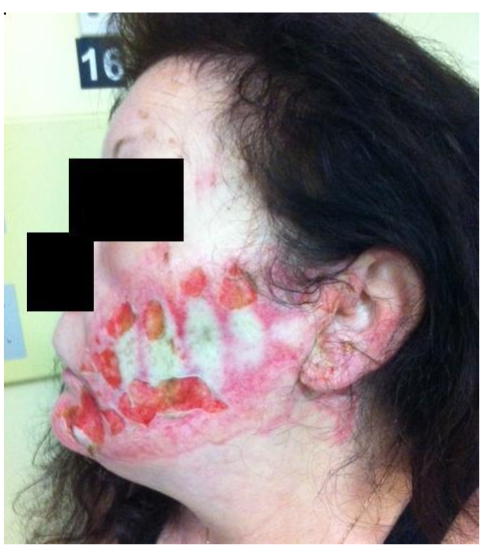
Prompt53 F collapsed face vs heater.
ResponseAssessment Issues
Cardiac monitoring/ECG/other investigations for cause of syncope
Assess for airway involvement
Assess for signs of head/neck/ other injury – e.g. fluctuant/altered GCS, lacerations, haematoma, haemotympanum
Tetanus status?
Burns description
Burn involves approx. 2% TBSA
Central area of full thickness burn (approx. 1% TBSA) with white/leathery appearance of skin and no capillary refill
Surrounded by partial thickness burn with evidence of deroofed blisters
Area extends from the patients left ear (involving the inferior 2 thirds of their helix, antihelix and the tragus), the majority of the patients left maxillary, mandibular andzygomatic areas, to the patient’s chin.
Left eye, lips and airway appear to be spared
Management
Administer first aid if not already received – cool running water for 20mins
Tetanus booster
Appropriate analgesia
Apply appropriate dressing (ie Silver-based eg acticoat) or bactigras
Refer to a burns centre as this is a full thickness facial burn that will require a skin graft – needs tertiary management
List adverse sequelae from this burn
Infection (left ear particularly at risk given it is a cartilaginous structure)
Involvement of facial nerve, resulting in facial droop on the left side
Permanent scarring
Others
Cardiac monitoring/ECG/other investigations for cause of syncope
Assess for airway involvement
Assess for signs of head/neck/ other injury – e.g. fluctuant/altered GCS, lacerations, haematoma, haemotympanum
Tetanus status?
Burns description
Burn involves approx. 2% TBSA
Central area of full thickness burn (approx. 1% TBSA) with white/leathery appearance of skin and no capillary refill
Surrounded by partial thickness burn with evidence of deroofed blisters
Area extends from the patients left ear (involving the inferior 2 thirds of their helix, antihelix and the tragus), the majority of the patients left maxillary, mandibular andzygomatic areas, to the patient’s chin.
Left eye, lips and airway appear to be spared
Management
Administer first aid if not already received – cool running water for 20mins
Tetanus booster
Appropriate analgesia
Apply appropriate dressing (ie Silver-based eg acticoat) or bactigras
Refer to a burns centre as this is a full thickness facial burn that will require a skin graft – needs tertiary management
List adverse sequelae from this burn
Infection (left ear particularly at risk given it is a cartilaginous structure)
Involvement of facial nerve, resulting in facial droop on the left side
Permanent scarring
Others
PromptConsent issues for intubated patient requiring escharotomy
ResponsePatient is critically unwell and will be unable to provide consent for this lifesaving procedure. He is unlikely to have capacity to consent given he is intoxicated, hypoxic and shocked and there is suspicion of self-harm.
We will treat this patient’s life-threatening injuries under the principle of Duty of Care (Guardianship Act) and proceed with treatment whilst attempting to notify next of kin or the Adult Guardian to inform them of the events.
Documentation all discussions and decisions carefully in the medical record.
We will treat this patient’s life-threatening injuries under the principle of Duty of Care (Guardianship Act) and proceed with treatment whilst attempting to notify next of kin or the Adult Guardian to inform them of the events.
Documentation all discussions and decisions carefully in the medical record.