TRAUMA - ADULT
CHEST - SHARP/PENETRATING
Prompt25m. Stabbed in chest. XR + Management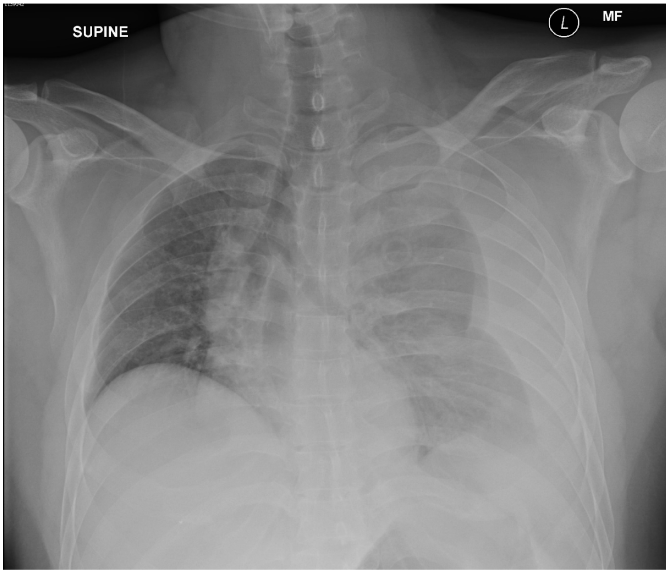
ResponseLarge hyperdense rim around entire L thorax
Mediastinal shift to Rt
Veiling across L hemithorax on supine film
Mgmt
Intubation
Left sided large bore ICC insertion
Blood transfusion following Massive Transfusion protocol guidelines to mitigate coagulopathy
Need to define 4th – TXA/Cardiothoracics
Mediastinal shift to Rt
Veiling across L hemithorax on supine film
Mgmt
Intubation
Left sided large bore ICC insertion
Blood transfusion following Massive Transfusion protocol guidelines to mitigate coagulopathy
Need to define 4th – TXA/Cardiothoracics
Prompt45M Stabbed to R chest x 1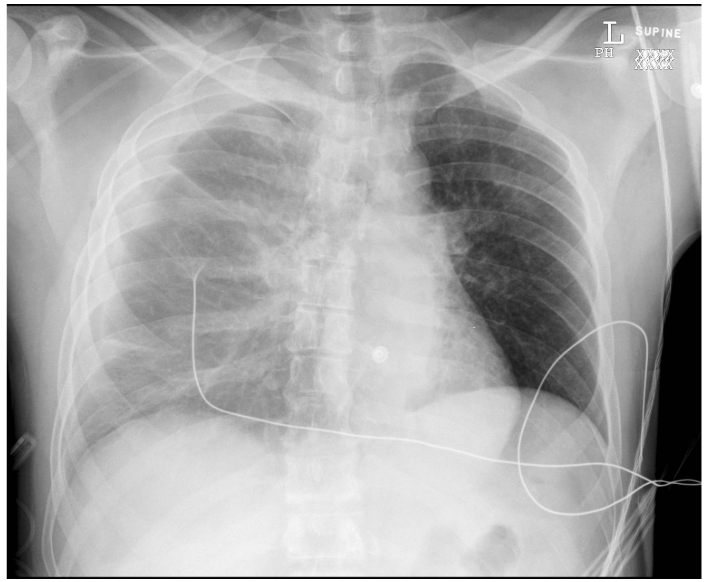
ResponseRight sided tension haemothorax (CRITICAL)
- Veiled opacity to right hemi-thorax
- Significant rim of fluid around lateral lung edge
- Mediastinal shift to left
Prompt25 M L stab wound x 1
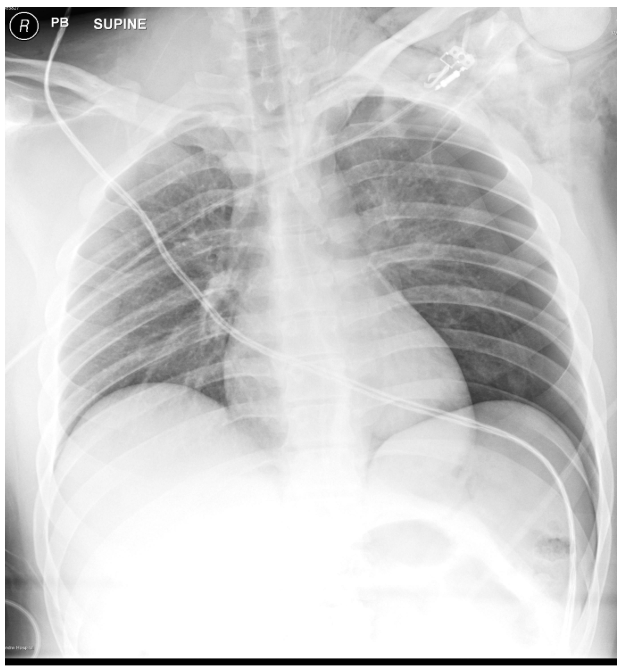
ResponseLeft sided pneumothorax (accept tension – rib spaces are widened)
supporting features
supporting features
- visible lung edge
- rim of lucency around lung edge
- widened rib spaces on left
- deep sulcus sign
Prompt46M, CXR findings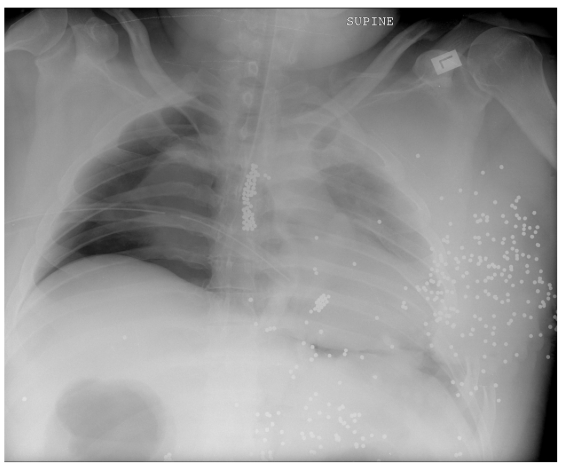
ResponseMultiple gun shot pellets over left hemithorax, possible mediastinum
ETT, possibly tip in RMB
Large right PTX with radiological tension
Right ICC crosses midline, requires new ICC or repositioning
Fractured left sided ribs
ETT, possibly tip in RMB
Large right PTX with radiological tension
Right ICC crosses midline, requires new ICC or repositioning
Fractured left sided ribs
Prompt23 M L sided chest stab wound
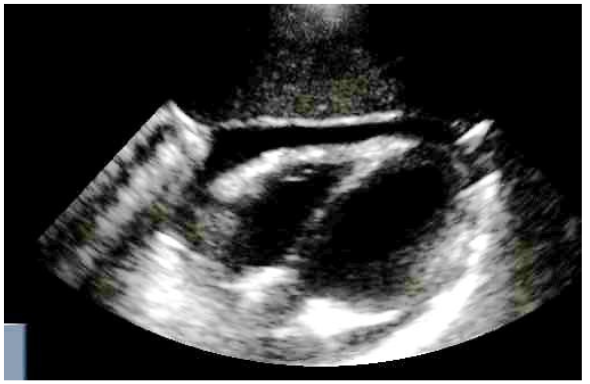
ResponsePericardial effusion (blood)
[pericardial tamponade is NOT demonstrated per se]
[pericardial tamponade is NOT demonstrated per se]
PromptList life threatening injuries from being stabbed in the chest multiple times
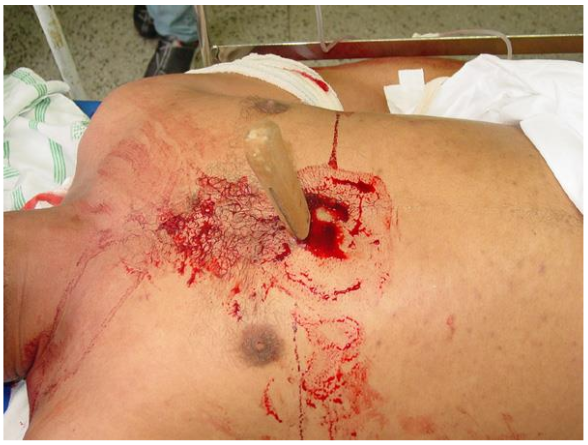
ResponseCardiac- rupture, tamponade, damage to coronary arteries/ STEMI, contusion
Lung- haemothorax, pneumothorax, pulm laceration, hilar injury, bronchial/ trachea
Vessels- aorta, coronary, intercostals, pulmonary artery/ vein etc…
Abdominal organs/ diaphragm/ oesophagus
Others- Neck/Head
(Note pic from slightly different q. Answers very similar)
Lung- haemothorax, pneumothorax, pulm laceration, hilar injury, bronchial/ trachea
Vessels- aorta, coronary, intercostals, pulmonary artery/ vein etc…
Abdominal organs/ diaphragm/ oesophagus
Others- Neck/Head
(Note pic from slightly different q. Answers very similar)
- Injury: Tension Pneumothorax
- Confirmation: CXR/E-FAST/Clinical signs
- Management: Decompression with ICC placement
- Injury: Massive Haemothorax
- Confirmation: CXR
- Management: Decompression with ICC, Volume resuscitation
- Injury: Cardiac Tamponade
- Confirmation: E-FAST, large effusion of pericardial view
- Management: Thoracotomy (in ED only if arrests)
- Injury: Visceral Laceration – ie liver/spleen/kidney
- Confirmation: CT with Active haemorrhage on CT(A) + free fluid
- Management: Surgical/Embolisation
- Injury: Great Vessel Injury (IVC/Aorta)
- Confirmation: CT (Angiography)
- Management: surgical
- Injury: Cord Injury with neurogenic shock
- Confirmation: Neurologic signs and CT Evidence of Spinal Laceration
- Management: Manage shock with fluids/noradrenaline, surgical involvement
Prompt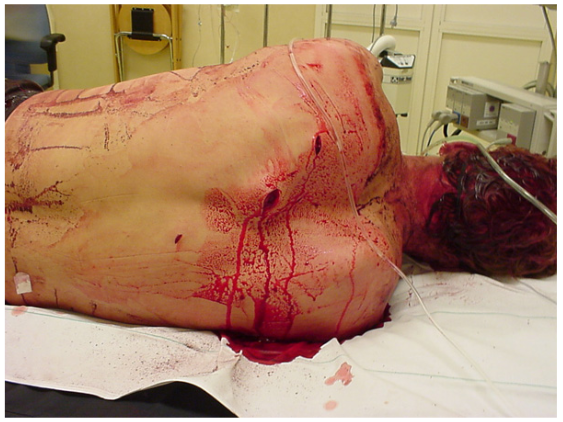
Response3 stab wounds to back
active bleeding
Proximate to heart – high risk of cardiac injury, likely PTx
active bleeding
Proximate to heart – high risk of cardiac injury, likely PTx
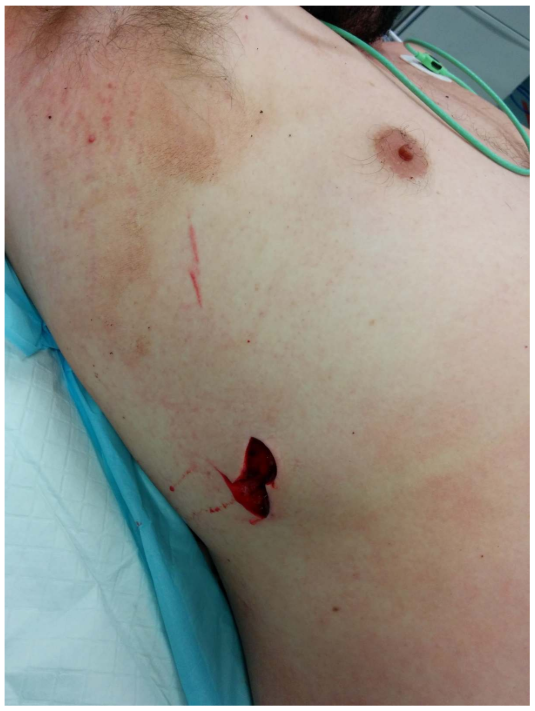
PromptThis man arrests posts an altercation. Immediate mgmt.
Response
- Finger thoracostomy: on the right (formalise to tube thoracostomy when able)
- Needs intubation, if tube not immediately placed.
- IV expansion: Blood if available , N/saline otherwise
PromptHow would you prepare for chest stabbing patients arrival
ResponseTeam- trauma team- allocate roles, ED reg, juniors, nurses, +/- anaesthetics, surgical reg, radiology- x-ray, brief them with plan, anticipate deterioration, PPE
Equipment- for intubation, thoracostomies/chest drain, thoracotomy, rapid transfusion, USS
Packed cells, TXA
Rest of Department- NUM, make sure other sick patients cared for, clear resus bay,
Rest of hospital
Equipment- for intubation, thoracostomies/chest drain, thoracotomy, rapid transfusion, USS
Packed cells, TXA
Rest of Department- NUM, make sure other sick patients cared for, clear resus bay,
Rest of hospital
- ED physician on call
- Cardiothoracics/ surgeons
- Theatres
- Anaesthetist
- ICU
- Blood bank- MTP
- Security/ police
- Social work/ media
PromptManagement of Traumatic Cardiac Arrest
ResponseMARCH, HOTT
PromptPost Resuscitation care after TCA
ResponsePrevent further cardiac arrest
- Re-evaluate ABCD frequently
- Confirm Airway position and patency
- Lung protective ventilation strategy: SpO2 94-98% (avoid hyper or hypo-oxia), PACO2 35-45 mmHg
- Ensure patency of ICC
- Minimum volume resuscitation: Blood rather than crystalloid, Permissive hypotension (SBP 80mmHg)
- Sedation & analgesia (ketamine 1mg/kg/hr IV)
- BSL: 4-10mmol/L (Normo-glycaemia)
- Trauma call/urgent surgical assessment : OT if unstable / maybe CT if stable
- Normothermia (~36°C)
PromptList interventions for penetrating chest trauma and their indication
Common Q but can be in lots of formats. “management of this pic” etc.
Common Q but can be in lots of formats. “management of this pic” etc.
ResponseThoracostomy/Intercostal catheter insertion – signs of tension pneumothorax or massive haemothorax i.e. evidence of PTX + hypotension/ hypoxia/ tachycardia/ marked resp distress /tachypnoea etc
Blood transfusion (accept massive transfusion) – ongoing specific numbers (SBP <80 or end-organ dysfunction, hypotension in ED)
Intubation – refractory hypoxia, agitation, cardiac arrest, to facilitate ICC or other painful procedures
ED Thoracotomy – cardiac arrest with pericardial effusion on EFAST
Others not acceptable i.e. supplemental O2, central access etc unless well justified
Blood transfusion (accept massive transfusion) – ongoing specific numbers (SBP <80 or end-organ dysfunction, hypotension in ED)
Intubation – refractory hypoxia, agitation, cardiac arrest, to facilitate ICC or other painful procedures
ED Thoracotomy – cardiac arrest with pericardial effusion on EFAST
Others not acceptable i.e. supplemental O2, central access etc unless well justified
PromptIndications for insertion of ICC
ResponseHypoxia
Ventilatory failure requiring Positive Pressure Ventilation (either NIV or Intubation)
Need for operative intervention (eg ankle operation)
Progressive pneumothorax or development of haemothorax
Ventilatory failure requiring Positive Pressure Ventilation (either NIV or Intubation)
Need for operative intervention (eg ankle operation)
Progressive pneumothorax or development of haemothorax
PromptList complications of ICC insertion and ways to avoid them
Responseextra-thoracic placement – ensure finger has entered thoracic space and guided passage of ICC
damage to intercostal vessels / nerve – ensure placement above rib not below
lung laceration – finger sweep on entering thoracic cavity, not use trocar
heart injury – avoid trocar, gentle insertion of ICC
diaphragm / abdominal organ injury – ensure placement in triangle of safety, lowest 5th interspace
infection – full sterile technique
damage to intercostal vessels / nerve – ensure placement above rib not below
lung laceration – finger sweep on entering thoracic cavity, not use trocar
heart injury – avoid trocar, gentle insertion of ICC
diaphragm / abdominal organ injury – ensure placement in triangle of safety, lowest 5th interspace
infection – full sterile technique
PromptList steps involved in inserting an ICC
ResponseVerbal consent / explanation
(sedation optional)
(Gown / gloves / mask / goggles)
Clean chest with anti-septic (appreciate this is a time critical procedure)
Local anaesthesia – lignocaine 1% with adrenaline 20mL
Location - 5th interspace mid-axillary line
Incision with scalpel
Blunt dissection to pleural space / finger sweep
Insertion ICC 28-32 Fr
Connection to underwater seal
Suture and dressing
Multiple answers - Random picked. all similar
(sedation optional)
(Gown / gloves / mask / goggles)
Clean chest with anti-septic (appreciate this is a time critical procedure)
Local anaesthesia – lignocaine 1% with adrenaline 20mL
Location - 5th interspace mid-axillary line
Incision with scalpel
Blunt dissection to pleural space / finger sweep
Insertion ICC 28-32 Fr
Connection to underwater seal
Suture and dressing
Multiple answers - Random picked. all similar
PromptIndications for ED thoracotomy
ResponseWidely accepted
- Penetrating chest injury with cardiac arrest/ peri-arrest non-responsive to resus measures and signs of life within previous 10 (? 15) minutes
- Penetrating non-thoracic trauma (e.g. abdominal, peripheral) with traumatic arrest and witnessed signs of life/cardiac activity
- Blunt trauma- with exsanguination from chest drain or pericardial tamponade seen on FAST or who lose signs of life/cardiac activity on arrival
PromptContraindications for emergency thoracotomy
ResponseUnwitnessed cardiac arrest blunt or traumatic
Severe head injury
Penetrating abdominal injury
Absence of cardiothoracic back up
Severe head injury
Penetrating abdominal injury
Absence of cardiothoracic back up
PromptList steps in performing a ED thoracotomy
ResponsePt to be intubated
Non-sterile procedure / PPE
Incision – need location and extent
Division of chest wall with appropriate scissors / gigli saw
Rib spreaders
identification of pericardium and phrenic nerve
incision pericardium to release tamponade
repair myocardial laceration if possible
(will accept either clam-shell or left lateral thoracotomy – details will need to match chosen technique)
Non-sterile procedure / PPE
Incision – need location and extent
Division of chest wall with appropriate scissors / gigli saw
Rib spreaders
identification of pericardium and phrenic nerve
incision pericardium to release tamponade
repair myocardial laceration if possible
(will accept either clam-shell or left lateral thoracotomy – details will need to match chosen technique)
PromptList procedures that can be done once the chest is opened
ResponseRepair of ventricular injury
Open cardiac massage
Cross clamp the aorta
Release pericardial tamponade
Open cardiac massage
Cross clamp the aorta
Release pericardial tamponade
PromptList survival rates following ED thoracotomy following traumatic arrest
ResponseIn penetrating chest trauma 15% (some studies as high as twice that)
In blunt trauma 1-2%
In blunt trauma 1-2%
PromptComplications of resuscitative thoracotomy
ResponseCoronary artery injury/ligation
Phrenic Nerve laceration
Diaphragmatic injury
Chest wall vascular injury (intercostals, internal mammary)
Infection
Health care worker body fluid exposure
Phrenic Nerve laceration
Diaphragmatic injury
Chest wall vascular injury (intercostals, internal mammary)
Infection
Health care worker body fluid exposure