TRAUMA - ADULT
NECK – SOFT TISSUE - BLUNT
Prompt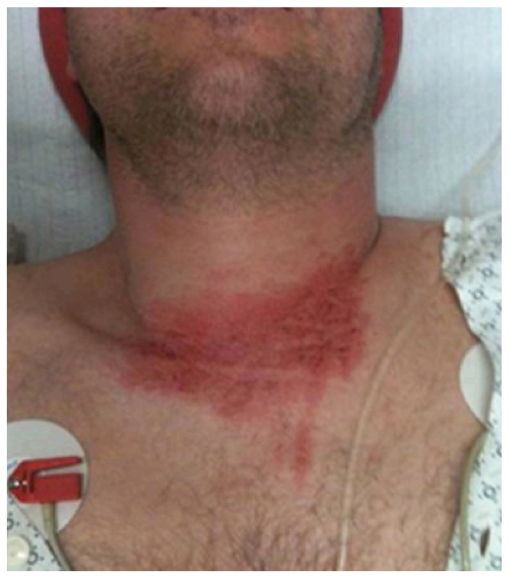
ResponseSignificant bruising/abrasions to anterior aspect of neck and upper sternum.
Assymetrical swelling/fullness of R side of neck
(No cervical spine immobilization)
(No definitive airway)
Assymetrical swelling/fullness of R side of neck
(No cervical spine immobilization)
(No definitive airway)
PromptMajor injuries of concern in above photo
ResponseLaryngeal fracture/trauma (1 mark)
Cervical spine fracture with neurogenic shock (1 mark)
Any of the following for up to 3 marks:
Cervical spine fracture with neurogenic shock (1 mark)
Any of the following for up to 3 marks:
- Carotid artery dissection/haematoma
- Thoracic aorta/Great vessel injury
- Traumatic brain injury
- Pneumothorax/Haemothorax
- Intrabdominal injury
PromptExamination features of significant laryngeal injury
ResponseHoarse voice / change in voice
stridor
Pain on swallowing
Haemoptysis
Subcutaneous emphysema
stridor
Pain on swallowing
Haemoptysis
Subcutaneous emphysema
PromptInvestigations to assess neck trauma
ResponseCTA neck
Fibre-optic nasendoscopy
Fibre-optic nasendoscopy
PromptImmediate management issues in hanging with low GCS
ResponseNeeds urgent intubation – anticipate difficult airway
Determine neuro status prior to RSI
Manual C spine immobilization to be considered
Neuroprotective measures
Determine neuro status prior to RSI
Manual C spine immobilization to be considered
Neuroprotective measures
- Head up 30deg
- Collar off
- Oxygenation, avoid hypercarbia
- Sedation/paralysis
PromptHanging prognostic indicators
ResponseDown time; first aid/BLS rendered, initial vital signs and GCS
Cardiac arrest at scene
Comorbidities
Previous/current injuries
Estimated height of hanging fall; potential for C spine injury
Cardiac arrest at scene
Comorbidities
Previous/current injuries
Estimated height of hanging fall; potential for C spine injury
PromptIndications for intubation
ResponseWorsening signs of airway obstruction, eg: from laryngeal oedema or expanding haematoma
Falling GCS and inability to protect airway
Threatened airway with vomiting++ or blood++
To definitively protect airway in light of predicted clinical deterioration
Respiratory failure from C-spine injury
To safely facilitate C-spine imaging/further management
Falling GCS and inability to protect airway
Threatened airway with vomiting++ or blood++
To definitively protect airway in light of predicted clinical deterioration
Respiratory failure from C-spine injury
To safely facilitate C-spine imaging/further management
PromptPros and cons of intubation in blunt airway trauma
ResponsePro
- Definitive airway for safe transfer – avoid needing to intubate enroute
- Urgency of transfer reduced
- Airway oedema may develop quickly – early intubation more likely successful
- Can apply cervical spine precautions once airway secured
- Difficult intubation without anaesthetics or ENT back-up – risk of failed intubation and cant intubate, cant oxygenate scenario
- Risk of worsening airway injury with intubation - converting partially transected airway into completely transected airway
PromptExpected difficulties during intubation in neck trauma and strategies to overcome these difficulties
ResponseDifficult intubation/Distorted anatomy due to loss of usual landmarks / changes to anatomy = Ideally intubate in OT by Anesthetics (fibre-optic, gas induction)
Conversion of partial to complete laryngo-tracheal disruption by blind passage of ETT and
Haemodynamic instability = Preload with fluids +/- pressors
Induction drugs – use Ketamine
Possible C spine fracture = Manual in-line stabilization + Videolaryngoscope
Conversion of partial to complete laryngo-tracheal disruption by blind passage of ETT and
Haemodynamic instability = Preload with fluids +/- pressors
Induction drugs – use Ketamine
Possible C spine fracture = Manual in-line stabilization + Videolaryngoscope
PromptIndications for immediate airway management in ED
ResponseArrest
Hypoxia
Tiring
Loss consciousness
Hypoxia
Tiring
Loss consciousness
PromptModifications to RSI in airway trauma
ResponsePre-oxygenate sitting up - Optimise airway positioning for patient, to maintain spontaneous ventilation
ETT size smaller - Airway oedema likely, risk of worsening injury with large ETT
Surgical airway site marked / second team prepared for surgical airway - High risk of failed supraglottic airway approach
Use of video laryngoscope (now standard of care ? no marks anymore)
Spontaneously breathing (no paralysis) - Use of paralytics may result in complete airway obstruction
In line immobilisation of C spine - Trauma patient, risk of C spine injury
ETT size smaller - Airway oedema likely, risk of worsening injury with large ETT
Surgical airway site marked / second team prepared for surgical airway - High risk of failed supraglottic airway approach
Use of video laryngoscope (now standard of care ? no marks anymore)
Spontaneously breathing (no paralysis) - Use of paralytics may result in complete airway obstruction
In line immobilisation of C spine - Trauma patient, risk of C spine injury
PromptIndications for CT angio of neck in strangling
ResponseCarotid bruit
Focal neurological abnormality
Horner’s syndrome
Hoarse voice
Haematoma – large / pulsatile / expanding
Significant ligature mark
Altered Conscious state
Subcutaneous emphysema
Think hard and soft signs!
Focal neurological abnormality
Horner’s syndrome
Hoarse voice
Haematoma – large / pulsatile / expanding
Significant ligature mark
Altered Conscious state
Subcutaneous emphysema
Think hard and soft signs!