CARDIOLOGY
BLOCKS + BRADYCARDIA
PromptECG’s - 3rd degree heart block***, PR prolongation, Bifascicular block
Response
PromptBlock types
ResponseYou know this
1st = Discharge
2nd type 1 = Discharge
2nd type 2 = Admission/telemetry/correct underlying cause/pacing or PPM
3rd deg AV block = Oh Fuck. Resus.
1st = Discharge
2nd type 1 = Discharge
2nd type 2 = Admission/telemetry/correct underlying cause/pacing or PPM
3rd deg AV block = Oh Fuck. Resus.
PromptBifascicular block – ECG findings and significance
ResponseEITHER
RBBB + LAFB (manifested as LAD)
RBBB + LPFB (manifested as RAD)
(in the absence of other causes)
Significance:
Bifascicular block can turn into 3rd degree heart block (may be intermittent >> Syncope, badness, etc)
In the context of chest pain bisfascicular block is highly associated with proximal LAD occlusion, even without ST changes.
Investigations:
Test for ischeamia – Stress echo, angiogram
Test for arrhythmias – Halter, Electrophysiology studies
Test for underlying structural heart disease and function – Echo
RBBB + LAFB (manifested as LAD)
RBBB + LPFB (manifested as RAD)
(in the absence of other causes)
Significance:
Bifascicular block can turn into 3rd degree heart block (may be intermittent >> Syncope, badness, etc)
In the context of chest pain bisfascicular block is highly associated with proximal LAD occlusion, even without ST changes.
Investigations:
Test for ischeamia – Stress echo, angiogram
Test for arrhythmias – Halter, Electrophysiology studies
Test for underlying structural heart disease and function – Echo
PromptLeft anterior fascicular block (LAFB) Criteria
ResponseLAD
qR complexes in I + aVL (ie: tiny Q, Big tall R)
rS compexes in II, III, aVF
Prolonged R wave peak itime in aVL >45 mS
qR complexes in I + aVL (ie: tiny Q, Big tall R)
rS compexes in II, III, aVF
Prolonged R wave peak itime in aVL >45 mS
PromptLeft Posterior Fascicular block (LPFB) Criteria
ResponseRAD
rS complexes in I+ aVL
qR complexes in II, III, aVF
prolonged R awave peak time in aVF
rS complexes in I+ aVL
qR complexes in II, III, aVF
prolonged R awave peak time in aVF
PromptTifascicular block
ResponseConduction delay in all 3 fascicles below the AV node (RBBB, LAFB, LPFB)
Manifests as bifascicular block + 3rd degree AV block
EITHER
Manifests as bifascicular block + 3rd degree AV block
EITHER
- 3rd degree AV block + RBBB + LAFB (= LAD)
- 3rd degree AV block + RBBB + LPFB (= RAD)
- My notes from somewhere
PromptLBBB ECG findings
ResponseQRS duration ≥ 120ms
Dominant S wave in V1
Broad monophasic R wave in lateral leads (I, aVL, V5-6) (V6: broad, notched (‘M’-shaped) R wave)
Absence of Q waves in lateral leads
Prolonged R wave peak time > 60ms in leads V5-6
Ischaemia = Sgarbossa Criteria
Dominant S wave in V1
Broad monophasic R wave in lateral leads (I, aVL, V5-6) (V6: broad, notched (‘M’-shaped) R wave)
Absence of Q waves in lateral leads
Prolonged R wave peak time > 60ms in leads V5-6
Ischaemia = Sgarbossa Criteria
- LITLF
PromptRBBB ECG findings
ResponseQRS duration > 120ms
RSR’ pattern in V1-3 (“M-shaped” QRS complex)
Wide, slurred S wave in lateral leads (I, aVL, V5-6)
RSR’ pattern in V1-3 (“M-shaped” QRS complex)
Wide, slurred S wave in lateral leads (I, aVL, V5-6)
- LITFL
PromptCauses of heart block
(and bradycardia)
(and bradycardia)
ResponseDrugs
Ischaemia/Infarction
- Ca channel blockers, Beta blockers, Digoxin, amiodarone, organophosphages
- PR prolongation – cholinergic agents, macrolides, Psychotropics
Ischaemia/Infarction
- RCA in particular but any
- Degenerative disease in conductive system, cardiac fibrosis
- Infiltrative disorders eg: sarcoid, amyloid, SLE, systemic sclerosis
Prompt3rd degree HB management (Or symptomatic bradycardia)
ResponsePlace patient on 15L O2 via NRB – aim saturations >94%
Atropine 600 mics IV every 3-5 mins total dose 3mg. Aim HR >60 and SBP>90 or MAP >65
Haemodynamic resuscitation – IV fluids + endpoint
2nd line drug therapy – adrenaline or Isoprenaline:
Adrenaline 25-50 mic bolus at beside
Isoprenaline or adrenaline infusion + dose
Analgesia with pacing – Fentanyl 15 mic IV aliquots Q5 min titrated to comfort. Sedation IV midazolam 1mg aliquots q5 min titrated to comfort
Seek and treat precipitant – Eg: calcium gluconate for hyperkalaemia
Disposition – ICU/Cath lab etc.
Endpoints – SBP>90, Pulse >50
Note: Atropine likely to fail in 3rd degree heart block (works on AV node which is often ischaemic) – poor answer. 600microg aliquots to 3mg
Atropine 600 mics IV every 3-5 mins total dose 3mg. Aim HR >60 and SBP>90 or MAP >65
Haemodynamic resuscitation – IV fluids + endpoint
2nd line drug therapy – adrenaline or Isoprenaline:
Adrenaline 25-50 mic bolus at beside
Isoprenaline or adrenaline infusion + dose
- Isoprenaline 2mg in 500 mL 5% dextrose (40 mics/mL) – star 0.05 mics/kg/min ~3mL/h and titrate to HR
Analgesia with pacing – Fentanyl 15 mic IV aliquots Q5 min titrated to comfort. Sedation IV midazolam 1mg aliquots q5 min titrated to comfort
Seek and treat precipitant – Eg: calcium gluconate for hyperkalaemia
Disposition – ICU/Cath lab etc.
Endpoints – SBP>90, Pulse >50
Note: Atropine likely to fail in 3rd degree heart block (works on AV node which is often ischaemic) – poor answer. 600microg aliquots to 3mg
PromptPros/cons different options
Response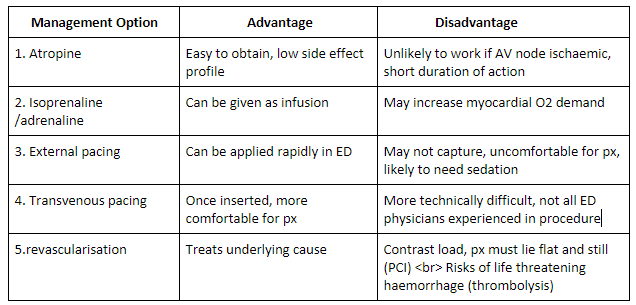
PromptCauses of bradycardia
ResponsePretty much the same as causes of heart block. Not repeated
PromptBradycardia management
ResponsePretty much the same as treatment of heart block. Not repeated. Atropine probably more likely to work if nodal brady
PromptExternal Pacing *** (maybe move to pacing?)
ResponseSee pacing.
PromptBifascicular block importance and causes
ResponseSee above
PromptInvestigations for Bifascicular block
ResponseSee above
PromptMobitz 2 ECG
ResponseSame as 3rd deg
PromptMobitz management
ResponseSame as 3rd deg
PromptChemical pacing agents
ResponseIsoprenaline (B1 Agnoist) – 2mg in 500 mL D5W – 0.05 mics/kg/min – start 15 mL/hg
Adrenaline – 4mg/100 mL D5W – start 0.05 mics/kg/min = 3 mL/h
Dopamine
Dobutamine
??Insulin (HIET) if Beta blocker/CCB overdose and no response to above
Adrenaline – 4mg/100 mL D5W – start 0.05 mics/kg/min = 3 mL/h
Dopamine
Dobutamine
??Insulin (HIET) if Beta blocker/CCB overdose and no response to above