CARDIOLOGY
MI
PromptStemi criteria definition
ResponseOngoing chest pain PLUS
STE >1mm in >= 2 adjacent leads, but in V3+V3 its
LBBB + Sgarbossa positive
ST depression in V1-V3 = posterior STEMI
De Winter waves V2-V5
STE >1mm in >= 2 adjacent leads, but in V3+V3 its
- >2.5mm <40 yo Male
- >2mm >40 yo Male
- <1.5mm Female of any age
LBBB + Sgarbossa positive
ST depression in V1-V3 = posterior STEMI
De Winter waves V2-V5
PromptECG’s - Love of inferior and right sided ECG’s + look for 3rd degree blocks.
Response
PromptSTEMI vs Pericarditis
ResponseSuggest STEMI
Anatomically contiguous ST and J point elevation
ST depression in aVL
ST elevation in III>II
Absent PR depression (although can occur in STEMI)
Reciprocal ST depression
Prolonged QT may be present
Dynamic ECG changes (Bolded cos I kept forgetting this)
ST elevation that is convex up or horizontal
Anatomically contiguous ST and J point elevation
ST depression in aVL
ST elevation in III>II
Absent PR depression (although can occur in STEMI)
Reciprocal ST depression
Prolonged QT may be present
Dynamic ECG changes (Bolded cos I kept forgetting this)
ST elevation that is convex up or horizontal
PromptHigh risk CP features
ResponseOngoing/repetitive chest pain
Persistent ST depression or T wave inversion in 2 contiguous leaads
Haemodynamic compromise
Syncope
Sustained VT
Known poor LV systolic function
AMI/PCI/CABG in last 6 months
Persistent ST depression or T wave inversion in 2 contiguous leaads
Haemodynamic compromise
Syncope
Sustained VT
Known poor LV systolic function
AMI/PCI/CABG in last 6 months
PromptLow risk CP features
ResponseNormal ECG
Normal troponin
Age <40
Absence of known CAD
Atypical symptoms
Chest pain resolved
Normal troponin
Age <40
Absence of known CAD
Atypical symptoms
Chest pain resolved
PromptCauses elevated troponin
ResponseCardiac
- Aortic dissection
- Cardiac contusion
- CCF
- Cardiomyopathy
- Cardiotoxic drugs (some chemo)
- Acute SAH
- Renal failure
- Sepsis
- Hypoxia
- PE
- cocaine
PromptCauses ST Elevation
ResponseCardiac
- Previous MI
- Pericarditis
- Myocarditsi
- Ventricular aneurysm
- Ventricular paced rhythm
- LBBB
- Coronay vasospasm
- Takotsubo cardiomyopathy
- Early repolarisation
- Cardiomyopathy
- Brugada
- Wellens
- ICH
- Hyperkalaemia
PromptSTEMI complications acute vs chronic
ResponseAcute:
- AV block
- Malignant ventricular tachyarrhythmia (VT/VF)
- Acure RV failure with loss of preload
- Cardiogenic shock (pulmonary oedema, B lines on POCUS)
- Acute MR from rupture of anteriolateral chordae ( new systolic murmur)
- Worsening angina
- Septal rupture (new loud holosystolic murmur)
- Ventricular free wall rupture
- LV aneurysm
- Mural thrombus, (PE, or DVT also)
- Dressler’s syndrome
PromptSTEMI Prehospital management
ResponseO2 to maintain sats 92-96%
Aspirin 300 mg PO
GTN /morphine if pain not controlled
Transfer directly to cath lab if available
Full monitoring including defib pads in transit
Aspirin 300 mg PO
GTN /morphine if pain not controlled
Transfer directly to cath lab if available
Full monitoring including defib pads in transit
PromptSTEMI management (non repurfusion stuff)
ResponseOxygen – saturations >92% (lots of targets seen).
Analgesia – fentanyl 25 mics or morphine 2.5mg
GTN
Seek and treat arrythmia/blocks (may need adrenaline/isoprenaline infusion
Antiplatelets, anticoagulation and repurfusion (see below)
- Optomising myocardial oxygenation
- Hyperoxia = increased infarct size (free radicles, reduction in coronary flow, and increased vascular resistance >> worse outcome)
Analgesia – fentanyl 25 mics or morphine 2.5mg
- Decrease pain and sympathetic activity which leads to decreased myocardial oxygen demand
GTN
- Vasodilation to increase myocardial perfusion
Seek and treat arrythmia/blocks (may need adrenaline/isoprenaline infusion
Antiplatelets, anticoagulation and repurfusion (see below)
PromptPCI vs Thrombolysis
ResponseSTEMI
PCI <60 mins, or contraindications for thrombolysis >>> PCI
PCI>60 mins >> Thrombolysis
PCI <60 mins, or contraindications for thrombolysis >>> PCI
PCI>60 mins >> Thrombolysis
- Successful >> admit vs transfer
- Unsuccessful >> PCI
PromptContraindictions for thrombolysis
ResponseAbsolute
- Symptoms present >12 hours
- BP >180/110
- Major trauma/Surgery/Internal bleeding <1 month
- Ischaemic stroke <3 months
- Intracerebral bleed ever
- Allergy to Tenecteplase
- Ischaemic stroke >3 months
- INR >1.8/Anticoagulation/Bleeding disorder
PromptDescribe your thrombolysis regime for acute STEMI (Describe at least 2 agents/doses/regimes)
Anticoagulation post thrombolysis
Anticoagulation post thrombolysis
ResponseBefore Thrombolysis:
Aspirin 300 mg + Clopidogrel (300 mg <75, 75 mg >=75) – PACSA
Then give TPa (directly converts plasminogen to plasmin - LITFL):
Tenecteplase 0.5mg/kg to 50 mg (Half dose if >75) - PACSA
Or:
Alteplase 15 mg bolus THEN 50 mg over 30 mins THEN 35 mg/kg over 60 mins (less if <65kg, total dose <1.5mg/kg) – Note this is a different regime to stroke which is different to PE – AMH
After thrombolysis - PACSA
Heparin – weight-based infusion no bolus (start 12-15 u/kg/h) – aPPT 60-80
OR
Enoxaparin (more complicated to memorise but easier to give as no infusion)
<75 yo = 30 mg IV @15 mins + 1mg/kg SC @30 mins
>=75yo – 0.75mg/kg SC at 30 mins
Aspirin 300 mg + Clopidogrel (300 mg <75, 75 mg >=75) – PACSA
- Prevent further platelet aggregation and limit further thrombi from forming and contributing to cardiac ischaemia
Then give TPa (directly converts plasminogen to plasmin - LITFL):
Tenecteplase 0.5mg/kg to 50 mg (Half dose if >75) - PACSA
Or:
Alteplase 15 mg bolus THEN 50 mg over 30 mins THEN 35 mg/kg over 60 mins (less if <65kg, total dose <1.5mg/kg) – Note this is a different regime to stroke which is different to PE – AMH
After thrombolysis - PACSA
Heparin – weight-based infusion no bolus (start 12-15 u/kg/h) – aPPT 60-80
OR
Enoxaparin (more complicated to memorise but easier to give as no infusion)
<75 yo = 30 mg IV @15 mins + 1mg/kg SC @30 mins
>=75yo – 0.75mg/kg SC at 30 mins
PromptSuccessful thrombolysis criteria
ResponseSymptoms largely resolved
HD stable
50% reduction in STE
HD stable
50% reduction in STE
PromptSTEMI management
ResponseBefore PCI:
Aspirin 300 mg
IV heparin 5000 U
Transver/Activation of interventional cardiology for PCI
Aspirin 300 mg
IV heparin 5000 U
- Prevent clotting and limit thrombus formation and hence ischaemia
Transver/Activation of interventional cardiology for PCI
PromptArtery distribution on ECG
Response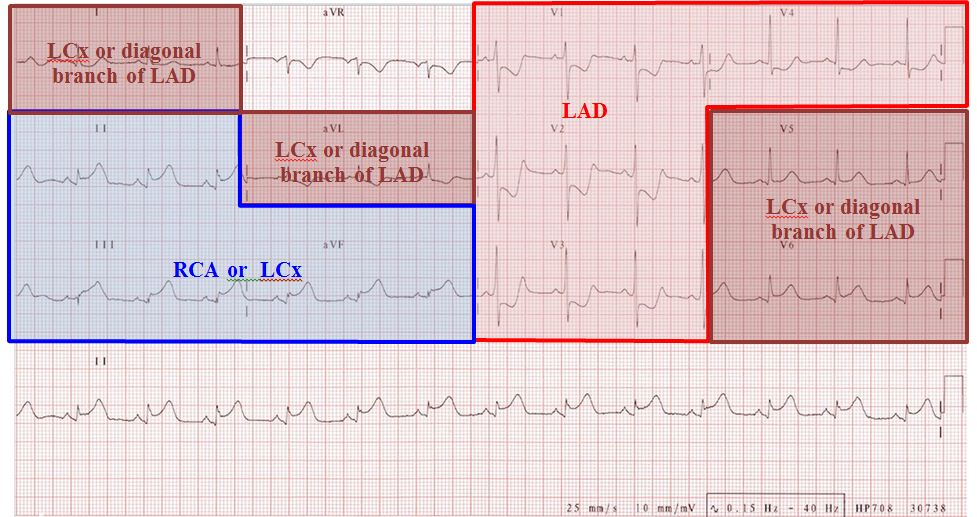
PromptNSTEMI management
Response
PromptSTEMI investigations (Non ECG - to confirm)
ResponseCardia biomarkers – Troponin/CK – Pattern of change will indicate if acute/recent infarct
Echo – Regional wall motion abnormality/hypokinesis (Sound like a boss, if given an ECG showing specific infarct – state that’s where you’d see motion defect!)
Posterior EG
CXR – pulmonary congestion/pleural effusion suggestive of significant myocardial infarction
Echo – Regional wall motion abnormality/hypokinesis (Sound like a boss, if given an ECG showing specific infarct – state that’s where you’d see motion defect!)
Posterior EG
CXR – pulmonary congestion/pleural effusion suggestive of significant myocardial infarction
PromptIndications for PCI in an arrest with ROSC
ResponseSTEMI preceeding cardiac arrest
STEMI on post ROSC ECG
New LBBB on post ROSC ECG
STEMI on post ROSC ECG
New LBBB on post ROSC ECG
PromptGlobal ST depression post Rosc on ECG - Significance
ResponseSuggests global ischaemia likely seocnary to prolonged arrest.
PromptPulmonary Hypertension/RVH ECG’s
Response
PromptRSI modifications in STEMI (Stem is going into heart failure with 88% sats NRB)
ResponsePreoxygenate sitting up
Add 15L O2 NP + NRB
Reduced dose induction agent
Adrenaline prior to induction (50 mics push vs infusion
Bag through apnoea
Add 15L O2 NP + NRB
Reduced dose induction agent
Adrenaline prior to induction (50 mics push vs infusion
Bag through apnoea