CARDIOLOGY
INFECTIVE ENDOCARDITIS
PromptDuke criteria
Response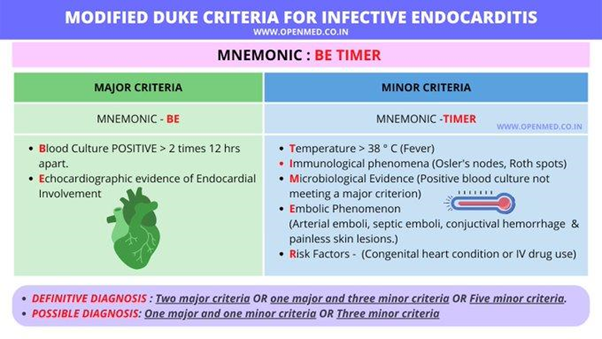
PromptList risk factors for infective endocarditis
ResponseIV drug use
Rheumatic heart disease
Congenital heart disease
Hx of previous IE
Prosthetic valves
HD pts
Immunocompromised
Dental infection/poor dentition
Male
Age >60y
Indwelling intravascular device
Pacemaker
HIV
Hx CABG
Rheumatic heart disease
Congenital heart disease
Hx of previous IE
Prosthetic valves
HD pts
Immunocompromised
Dental infection/poor dentition
Male
Age >60y
Indwelling intravascular device
Pacemaker
HIV
Hx CABG
PromptBacteria (IVDU/Valve replacment/Normal human)
ResponseIVDU: 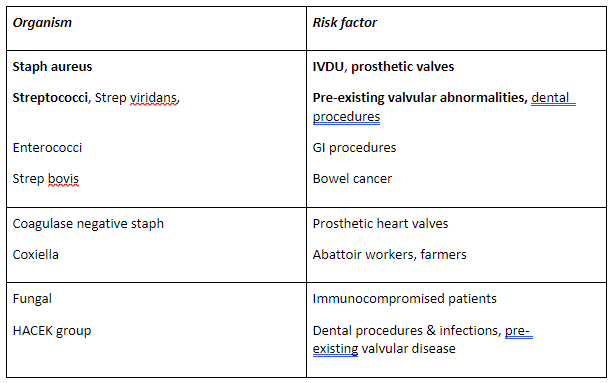
- Staph Aureus
- Streptococcal species – Strep Viridans
- Pseudomonas aeruginosa
- Fungi – candida Mixed organism
PromptAntibiotics for infective endocarditis
Response(From eTG 4/2024 – answers differ a bit)
NATIVE valve
NATIVE valve
- Benpen 1.8g Q4H PLUS Fluclox 2g Q4H PLUS Gent (swap benpen for vanc if MRSA suspected)
- Cefazolin 2g TDS PLUS Vanc 25-30 mg/kg loading PLUS gent (If penicillin allergy)
- Vancomycin PLUS Gent if penicillin anaphylaxis
- Fluclox 2g Q4H PLUS Vanc 25-30mg/kg loading PLUS Gent
- Cefzol 2g TDS PLUS Vanc 25-30 mg/kg loading PLUS gent (If penicillin allergy)
PromptInvestigations – list and justify in infective endocarditis
ResponseTTE - Assess for vegetations, valvular injury/regurg, lower sensitivity than TOE but more accessible (60-% sensitive for vegetations) – also assess ventricular size, function, regurgitation, haemodynamics
TOE (must have either TOE or TTE) - Higher sensitivity for vegetations, abscesses
Blood cultures – 3 sets from 3 separate sites, before antibiotics given - Duke criteria
Increase chance of identifying pathogen, antimicrobial sensitivities.
Others – CRP, ESR, FBC - Raised inflammatory markers, anemia common with IE
ECG - Assess for conduction abnormalities - No specific finding for IE. Helps identify complications: myocardial ischaemia CHB, AV block & bundle branch blocks, arrhythmias
Urinalysis - Haematuria – present in about 50% secondary to emboli to kidneys
CXR - No specific finding for IE , Helps identify complications: multiple bilateral pulmonary infiltrates-> septic emboli, APO, Pneumonia
CT Chest/Abdo - Looking for complications to chest & abdo – septic emboli, Abscesses, distal infarctions
FBC - WCC not sensitive to IE – can be normal, raised, depressed Haemolytic anaemia maybe present
ESR/CRP - Sensitive but not specific, elevated in >90% cases
TOE (must have either TOE or TTE) - Higher sensitivity for vegetations, abscesses
Blood cultures – 3 sets from 3 separate sites, before antibiotics given - Duke criteria
Increase chance of identifying pathogen, antimicrobial sensitivities.
Others – CRP, ESR, FBC - Raised inflammatory markers, anemia common with IE
ECG - Assess for conduction abnormalities - No specific finding for IE. Helps identify complications: myocardial ischaemia CHB, AV block & bundle branch blocks, arrhythmias
Urinalysis - Haematuria – present in about 50% secondary to emboli to kidneys
CXR - No specific finding for IE , Helps identify complications: multiple bilateral pulmonary infiltrates-> septic emboli, APO, Pneumonia
CT Chest/Abdo - Looking for complications to chest & abdo – septic emboli, Abscesses, distal infarctions
FBC - WCC not sensitive to IE – can be normal, raised, depressed Haemolytic anaemia maybe present
ESR/CRP - Sensitive but not specific, elevated in >90% cases
PromptComplications
ResponseSeptic pulmonary embolic from valvular vegetations
Heart failure secondary to valvular regurgitation/insufficiency, accept cardiogenic shock.
Cardiac ischaemia secondary to valvular disease, cardiogenic shock, septic shock, arrhythmia
Septic shock secondary to untreated infective endocarditis – may have been unwell for some time in the community
Arrhythmia secondary to local myocardial abscess, septic shock, heart failure
Systemic embolic to spleen &/or kidneys – another explanation for left sided chest pain (referred pain) or causing diaphragmatic irritation
Cerebral emboli – maybe contributing to a delirium and explain why wants to DAMA.
Joint emboli – explaining why aching all over 9although this could be due to high fever & sepsis
Think of the Duke Criteria as complications
Heart failure secondary to valvular regurgitation/insufficiency, accept cardiogenic shock.
Cardiac ischaemia secondary to valvular disease, cardiogenic shock, septic shock, arrhythmia
Septic shock secondary to untreated infective endocarditis – may have been unwell for some time in the community
Arrhythmia secondary to local myocardial abscess, septic shock, heart failure
Systemic embolic to spleen &/or kidneys – another explanation for left sided chest pain (referred pain) or causing diaphragmatic irritation
Cerebral emboli – maybe contributing to a delirium and explain why wants to DAMA.
Joint emboli – explaining why aching all over 9although this could be due to high fever & sepsis
Think of the Duke Criteria as complications
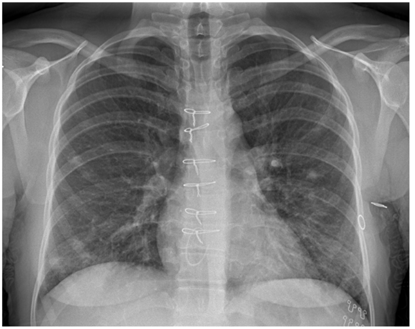
PromptCXR interpretation (look for valve replacement, round patches - septic emboli)
CXR findings:
Sternotomy wires
Circular opacity in region of valve consistent with valve replacement or repair.
Multiple small rounded opacities in both lung fields suspicious for septic emboli.
No confluent consolidation seen
Diagnosis:
suspicion of infective endocarditis (most likely secondary to IVDU) / infection of prosthetic valve also possibility
CXR findings:
Sternotomy wires
Circular opacity in region of valve consistent with valve replacement or repair.
Multiple small rounded opacities in both lung fields suspicious for septic emboli.
No confluent consolidation seen
Diagnosis:
suspicion of infective endocarditis (most likely secondary to IVDU) / infection of prosthetic valve also possibility
Response